
Halki
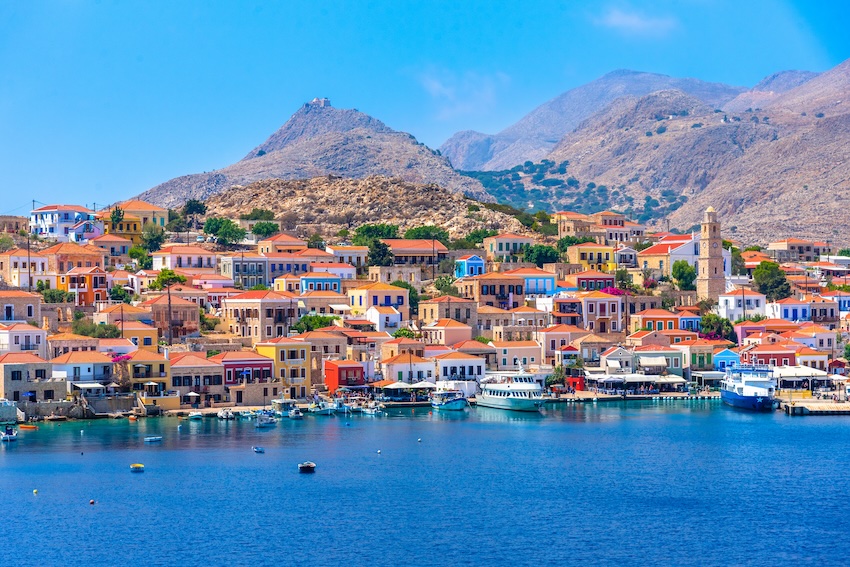
Photo by Giorgios Tsichlis
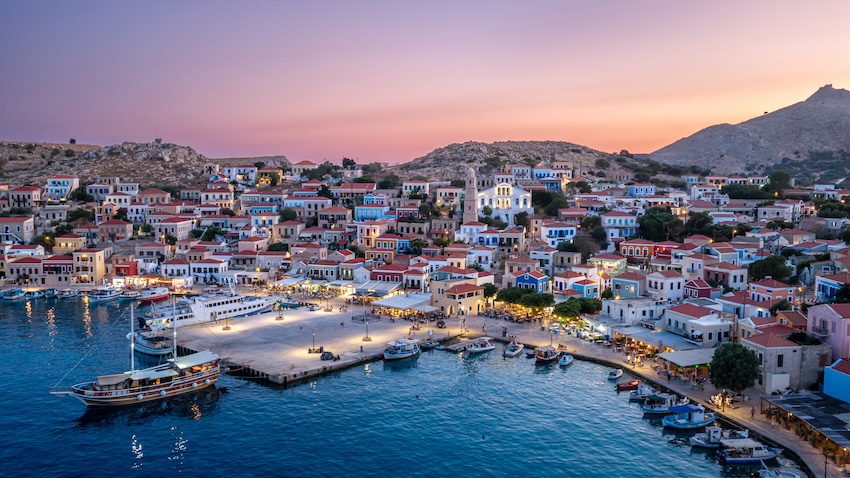
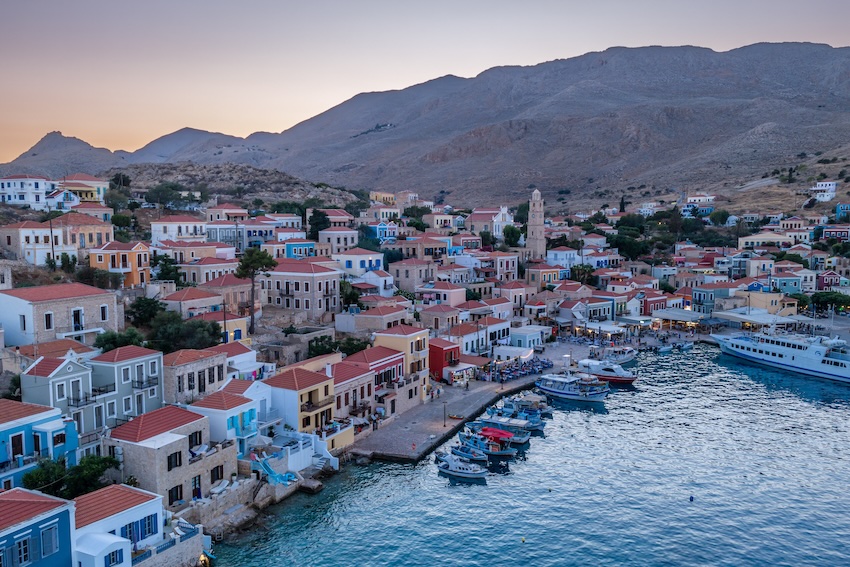
The Island of Halki by J. Kathleen ThompsonOne in a chain of eye-popping islands in the southern Dodecanese, Halki will have you smitten at first sight. As the ferry rounds the island of Nisos, and the tableau of toy-like mansions poised between an Italianate clock tower and a sky-bent church belfry appear above the harbour, you will be persuaded to abandon all other plans but to disembark mid-Emborio. It’s something about being caught between a whimsical past and a vibrant present, with windmills and castles and neo-classical grace hovering over a dockside buzzing with new arrivals and cafes opening for the day. About colourful caiques on luminous waters, bright orange and rose coloured buildings against stinging blue skies, Or maybe it has something to do with the island’s epithet - The Island of Peace and Friendship - which conjures images of shared tables under starlit skies.You sense that this tranquil dream of an island would reward a visit, scheduled or not. You join the legions disembarking. |
|
|
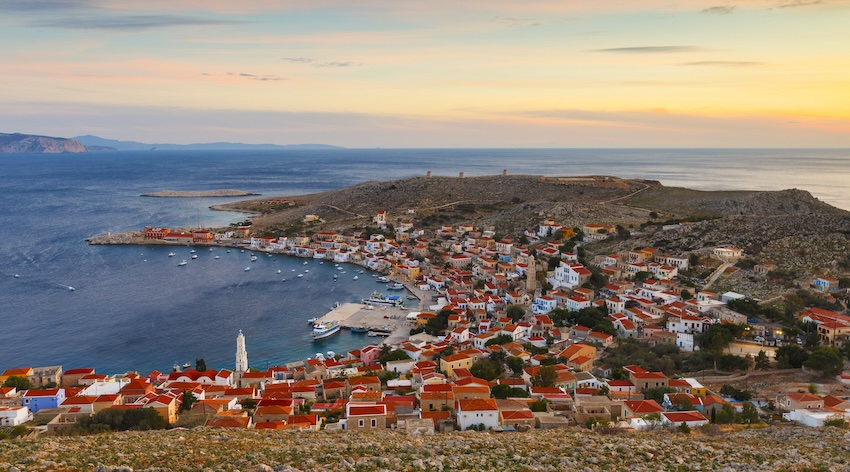
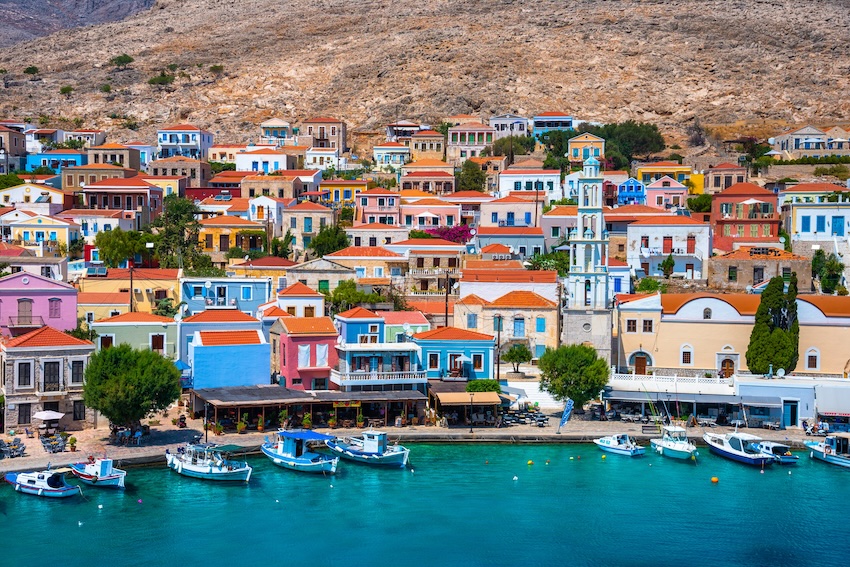
Exploring EmborioAlighting from the ferry will instantly immerse you in this fairyland first glimpsed from the sea; a composite of multi-storied, multi-hued buildings, all playfully vying for your attention. Inspired by the Venetians and built in the halcyon days of Halki’s sponge-fishing trade, the buildings’ chic designs and bold colour schemes beg closer examination. As you tuck into the narrow winding passageways (fittingly called ‘rimes-reemes’, or ‘breathe in’) to admire the Venetian beauties, there is a good chance you will spot someone hovering over a canvas or a manuscript; Halki is the island of choice for people who like quiet retreats in picturesque places..The alleys that climb the highest yield expansive views of the harbour below, its piercing aquamarine waters finessing a scene of astonishing beauty. You pass the landmarks you saw from the ferry - Agios Nikolaos (after the saint believed to have stopped on Halki) with its five-tiered bell tower and large pebbled mosaic floor - and the freestanding, now silent clock which was a gift of the Halkites who had immigrated to Tarpon Springs, Florida. You might note the Sarentzi Art Centre (housed in a former Ottoman cistern) beside the clock tower and the Palladian-styled town hall behind it. Exploring Emborio, the hub and heartbeat of life on Halki, is a routine pleasure and will draw you back again and again between ventures to further corners of the island. |
|
|
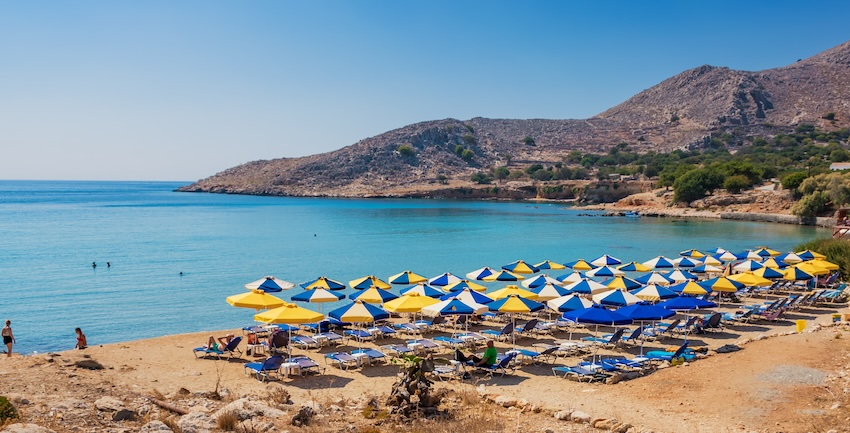
Beaches of HalkiHalki has three popular, easily accessible beaches. If you follow the ‘rimes-reemes’ to the south side of the harbour, you will fall into a path that takes you past Agia Aikataerini to the small Ftenagia beach with a few sun beds aside a beachfront tavern. Given the rocky inlets close by, snorkelling is reputedly good here. If you’re looking for a little more room, head for the largest beach on the island, Pondamos. You can get there either by taking the circuitous route via the windmills and hilltop cemetery, or the main road, Tarpon Springs Boulevard (yes, named after its benefactors in Florida), which ascends directly from the ferry dock. The fifteen minute walk will bring you to the wide, shady beach that, with its gentle gradient to the sea, abundant sunbeds and seaside taverna, is popular with all ages. Another easily accessible beach is Kania, a forty-five minute walk on a paved road east of Emborio, or a ten-minute taxi boat ride away. It lies snug in a cove, with room just enough for sun beds, a garden and a cosy taverna. The more adventurous might want to return via the path around the headland to the far northern corner of Emborio. A number of other beaches - Areta, Dio Giali, and Lemnes and Flea on Trachia Peninsula among them - are accessible via the taxi boat, the Giannis Express. Look for the blackboard next to the taxi in the harbour for daily destinations, rates and times. |
|
|
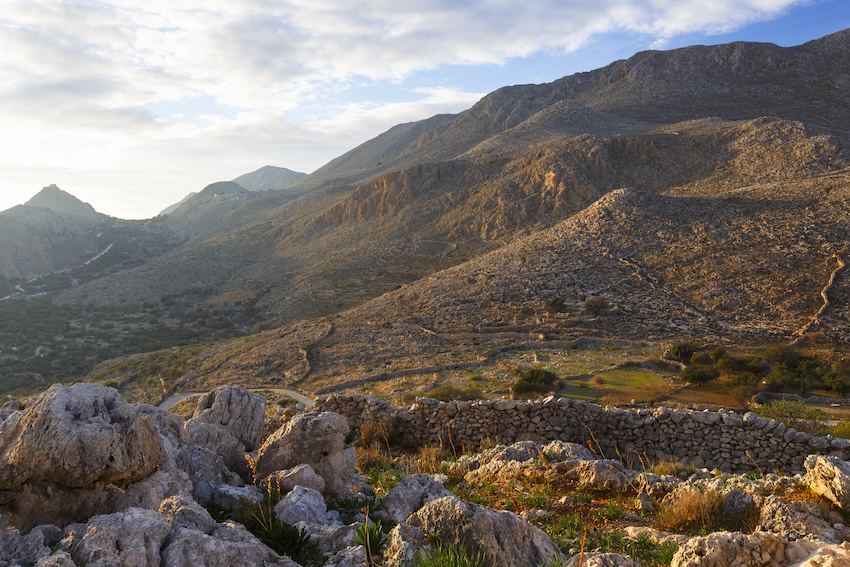
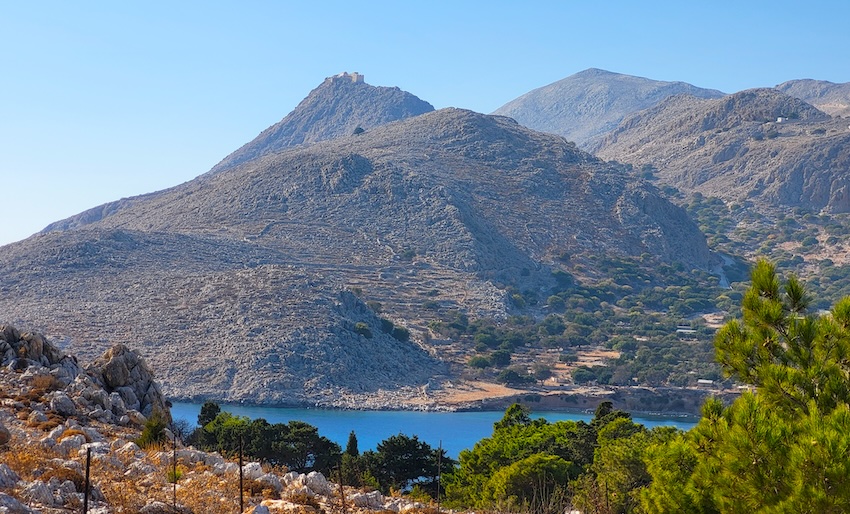
Trails of HalkiFor those with an interest in the island’s wilder side, venturing beyond Emborio and beaches nearby offers fascinating glimpses into Halki’s rich history and unique geography. To chart your way, install the Anavasi Topo Islands Hiking app, or pick up the map at any of the mini-marts on the island. At the top of your list will be the richly rewarding walk to Paleo Chorio and the Hospitaller Castle above it, about four kilometres from Emborio. Follow Tarpon Springs beyond Pondamos beach and start ascending into the dry mesa of the island. The now almost deserted town emerges perfectly camouflaged on the flank of an inland-facing hill, with the castle on guard one thousand metres above. A clear and well signposted path weaves through Chorio, its three churches and occasional renovated building standing in stark contrast to the crumbling ruins of the ancient village. Climbing steeply and passing a short detour to the thrones of Zeus and Hekate (don’t miss taking this detour; where else are you going to get the chance to sit on thrones of two of the most powerful ancient Greek gods?), the trail to the castle ramparts and their commanding views of vast swaths of the Aegean Sea and Halkii’s shoreline, takes about forty-five minutes. Reminiscent of Lindos in Rhodes, the ancient setting is eclipsed by the sheer magnificence of stone, sky and sea. Like writer Henry Miller’s paean to the Greek landscape, here be “Peace and joy, dust and heat, sea and sky, God and angel.” While Chorio and the castle draw the most visitors, continuing up the spine of the island to reach Agios Ioannis O Alarga (the Monastery of St. John the Far) promises a deeper dive into Halki’s past. Most notable on your journey (which you will either be doing on foot or by taxi as there are no public buses nor hire cars or scooters on Halki) will be the monasteries and churches with frescoes that date back to the 10th century, and a proliferation of drystone walls, terraces, threshing circles, cisterns and kypes - drystone gardens or enclosures that once were dwellings but now are shelters for the island goats and sheep. Oh, and did I mention the stunning views of the far off islands of Tilos and Symi from these high plateaus? A number of trails continue further into the western hinterland of the island as far as Cape Mirtos and Cape Tsagariou. Not far from the monastery is a series of caves, including the Kamenos Spilios (Burned Cave) whose name reveals its tragic history. Here, in 1658, women and children on the island were ordered to hide from the oncoming Venetian fleet led by admiral Francesco Morosini who was bent on avenging Halki’s support for the Venetians’ enemies, the Ottomans. They were found, and, trapped inside the cave, consumed by a fire set by Morosini’s crew. Blackened walls at the mouth of the cave still attest to this heartbreaking event in Halki’s history. There are other trails on the island, some of which lead to sites of interest such as the Temple of Apollo, off the road to Kania, and other remote beaches. However, bear in mind that the trail network on Halki is limited and trail maintenance is a labour of love by volunteers from a pool of busy residents and itinerant visitors. Be prepared for rugged conditions, dry terrain and route-finding challenges (in other words, wear boots, and pack your water and patience!). Also, erosion and weather events can close trails - pay attention to the signs! |
|
|
Halki HistoryThough small (four kilometres wide, twenty-eight kilometres square), barren (no natural water sources, least vegetated island in the Aegean), and mountainous (peaks of 500/600 metres falling precipitously to the sea on all sides), Halki has had a surprisingly long history of habitation. Archeological finds date back to Neolithic times, and traces of obsidian tools, arrowheads and ceramic shards suggest that settlement continued well into the Late Bronze Age. Though largely a vast limestone plateau, deposits of both copper (chalkos in ancient Greek) and murex shells (kalchi in Phonecian) likely led to it being referred to as ‘Chalki’ by the Minoans and Mycenaens when they were exploring in the area. And if we cobble together the evidence - some brief mentions by ancient historians Theophrastus and Thucydides, grave goods from a 5th-3rd BCE tomb close to Pondamos, wide cultivation of crops and livestock and extant shrines to ancient Greek gods - we can confirm that Halki had an active presence during the Hellenistic era. Indeed, as part of the Rhodian League, it is believed that Halki helped in the defense of the Athenian empire during the Peloponnesian war by sheltering a fleet of its ships from the enemy fleet in Rhodes. The Byzantine era saw steady development of the island’s settlements and fortresses, all which were further fortified by the Knights Hospitaller (aka Knights of St.John) when they arrived in Rhodes and the surrounding islands in 1306. With the added protection of the knights and increased trade and activity, Paleo Chorio and surrounding settlements grew and flourished, leaving behind the large number of chapels, ruins and terracing that lie scattered and abandoned around the island today. The next boom for Halki came in the 19th century. While farming on Halki had always been a Herculean task (given its terrain and lack of water), harvesting its prolific underwater gardens and sponge beds had been much easier. With the advent of the diving suit - skafandro - and increasing demand for the sea sponge, sponge fishing boomed in the 19th century, bringing with it a sudden increase in population and wealth (hence, the neo-classical homes that still ring Emborio’s harbour). In 1902, Halki’s population exceeded 3,000 residents. A reduction in sponge stocks, restrictions on sponge fishing during the Italian occupation in the early 20th century and scuttling of the farming industry during the German occupation in World War II, however, led to the mass exodus of the population to more hospitable climes. Many islanders immigrated to other fledgling sponge fishing grounds like Tarpon Springs, Florida. By 1981, Halki was almost deserted. Then, sparked by the ‘discovery’ of Greece by sun-and-sea seeking northerners, Halki, like its neighbours, shifted its attention to tourism. Anointed the ‘Isle of Peace and Friendship’ by UNESCO in 1983, it gradually grew its reputation as a place to unplug and tune into the joys of slow meanders, sun-warmed sand, and soft evenings by the sea. It’s a formula that never loses its appeal; today, Halki’s following is legendary, and considering its bijoux size, sustained with care. |
|
|
Halki TodayThe (approximately) 330 people who make Halki their permanent home continue the island’s project of regeneration and rebranding as a low-key eco-friendly paradise. Being the first island, along with Tilos, to sign up for the Greek government’s GR-Eco Islands Initiative in 2021 has given Halki a head-start on its transition to becoming a green island. The first clue that Halki is well on its way to embracing eco-efficient technologies are the electric Smart cars used by the police, coast guard and municipality. Other developments are the 1 MWp solar park, fish farm and de-salination plant that lie on the road past Kania beach. Future plans to build an Interactive Park of Innovation and New Technologies near the helipad, and to adopt Greece’s new Urban Resilience plan (which supports green transitions and climate adaptation strategies)) further underscore Halki’s commitment to development that is on a scale sustainable to the island. Sensitive to industries that might sabotage the island equilibrium (as did the turbo-charged sponge fishing in the late 19th century), Halki is reclaiming control of its own vision for the future. |
|
|
Visitor Services on HalkiIf you were to ask a resident to name the top five must-do activities in Halki, they would probably be reluctant to atomize the Halki experience. Rather, like Phaedra Clarke, once a summer visitor and now raising her family and running a restaurant on Halki, they will point out that, “It’s not so much separate experiences as it is one whole experience from start to finish. It’s a place to just let life flow and see where it takes you.” Similarly, another longtime devotee of Halki, Seren Ariella, suggests that ‘unplanning’, given the tranquillity of the environment, is a perfectly legitimate planning strategy when on Halki. “The essence of Halki is that one explores as much or as little of this tiny island as time or energy permits. And you’ll do it to the sound of crowing cockerels, the bleating of a goat and the ringing of church bells!” If pressed, in addition to losing one’s self to the wash of beauty that surrounds the harbour, locals may mention something about the beaches, the walk to the abandoned village and castle, and possibly, the boat tours available. It’s good to know, even if peripherally, that there are these amenities on the island: 1) Island transportation. Vehicles are restricted on Halki, and there are no car rental agencies. There is consistently at least one taxi (a nine-seat mini-bus) that offers service to any of the three beaches, Paleo Chorio, the Monastery of St. John the Far, and Taverna Lefkosia In the evening. A water taxi service, Giannis Express, offers boat tours to the more remote beaches on the island and to island of Alimnia, where buildings on this once important outpost have recently been restored. If you’d like to be captain of your own vessel, you can rent boats from Chalki Boat. Both services are located on the waterfront, south of the ferry slip. For yachties,a new pontoon wharf moors up to twenty vessels, providing waterside hookups for water, electricity and wifi. 2) Diving instruction and equipment. Located on Tarpon Springs as you leave town, the Chalki Dive Centre offers Pedi instruction and private scuba and snorkel boat tours. 3) Retail shops. There are three mini-marts and a pharmacy on the island. A number of other shops supply souvenirs, locally made art, and general summer essentials. You will find Ria’s Souvenir Shop, Eleni’s Art Boutique, Queen of Halki Artwork (who will also take custom orders), and F&T Tsagaris Sandals and Accessories close to ferry dock, or on Tarpon Springs.There is one ATM, located at the base of ferry slip. 4) Museums. Stepping into the Traditional House of Halki, a 19th century family home turned into a folklore museum, will familiarize visitors with local history and traditional customs. The Archaeological Museum of Chalki, part of the Ministry of Culture and Ephorate of Antiquities’s ambition to establish museums on every island, was inaugurated in June, 2026. Its permanent exhibition highlights recent archaeological finds on Halki and its satellite islands. 5) Cultural Events. Halki has a vibrant festival calendar, proudly putting its traditional music, dance, costumes and food on display at multiple times during the year. The “Start of the Sponges” in late April/May recollects the traditions of sponge-diving in the Dodecanese, and the Halki Friendship and Tradition Festival in May celebrates, in collaboration with other Dodecanese islands, Dodecanese culture. The Orthodox observance of The Dormition of the Virgin in mid-August is marked by a three-day celebration held primarily at Panagia Choriani in Chorio and The Monastery of St. John the Far. A traditional welcome is given to participants in the Aegean Regatta, which overnights in Halki every August. In September, the island is host to the Athens State Orchestra whose annual visit draws both day and overnight visitors, filling the island to capacity. A perfect backdrop for retreats as well, Halki hosts the Halki Yoga Love retreats every year in May and September, and Nissia Holidays sponsors two painting retreats each year. |
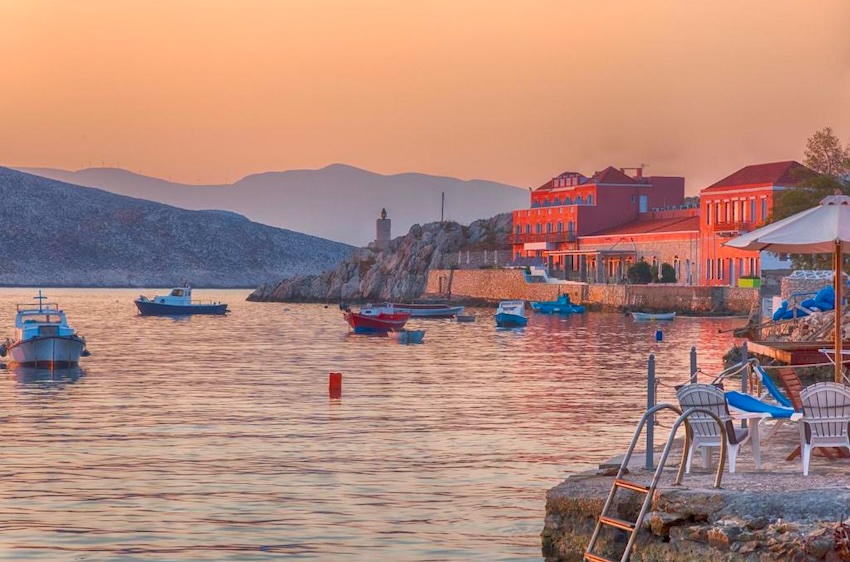 |
AccommodationIf you have always wanted to stay in a neo-classical mansion, you will be well served on Halki! Indeed, apart from Aretanassa Hotel, the renovated sponge warehouse at the southern end of the harbour, private villas and homes are the staple of visitor accommodation on the island. If you are booking independently, it is wise to book well in advance of travelling during peak season. See Halki Hotels and other Accommodations |
|
|
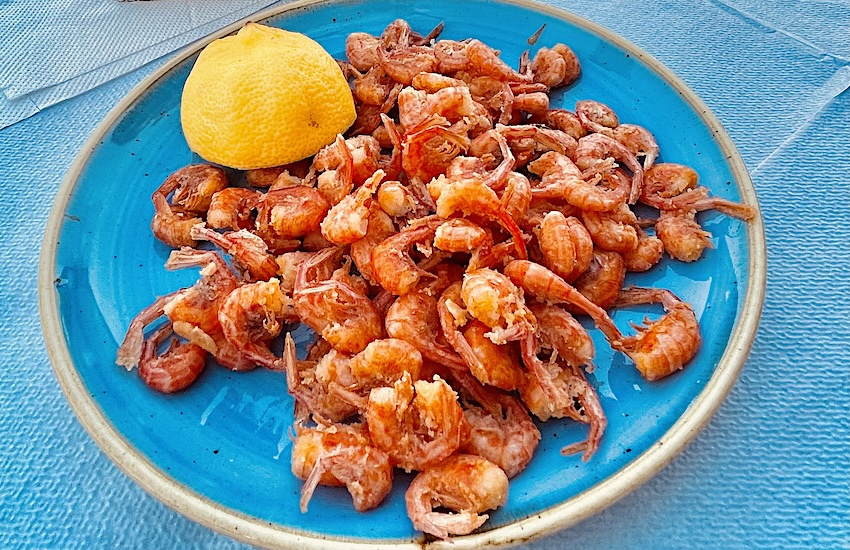
Eating Out on HalkiCentral to Halki’s attraction as a place to relax and refresh - and be spoiled - is its fine culinary scene. Starting with its popular centrally located village bakery, Dimitri’s (whose spanokopita comes highly recommended), restaurant owners take pride in the island’s offerings, including the island speciality of handmade Halki pasta cooked with onions and cheese and locally sourced shrimp. Most eateries are situated in the curve of the harbour, and most are seasonal (April/May - Oct/Nov). For seafood and Mediterranean fare, search out Valentis Restaurant, Taverna Babis, Taverna Maria, Magefseis Restaurant Taverna or Black Sea Restaurant (the latter two which are also great places to try the island specialty). Many of these restaurants are vegetarian friendly as well. Kefi Grill Restaurant is known for its souvlaki and grilled meat,the newly opened Gyros of Chalki for its eat-in or takeaway gyros, and Halkitissa for its homemade pasta and pizza. Don’t forget the three beach tavernas (Ftegania, Nick’s at Pondamos, and Kania) and Taverna Lefkosia in Chorio which serves traditional Greek food in the evening. A number of cafe/bars offer service throughout the day, from morning coffee to evening cocktails (and will be the place to watch televised sport finals), such as Costas, the new Crazy Balls, Steki Cafe Bar, Apaggio Tavern, Apostolis Cafe Bar and the Piazza Cafe Bar. Have a dish of homemade ice cream at The Twins Cafe Bar (named after the Karpathian siblings who live in the US when not behind the bar In The Twins) while you are waiting for your ferry to arrive. |
|
|
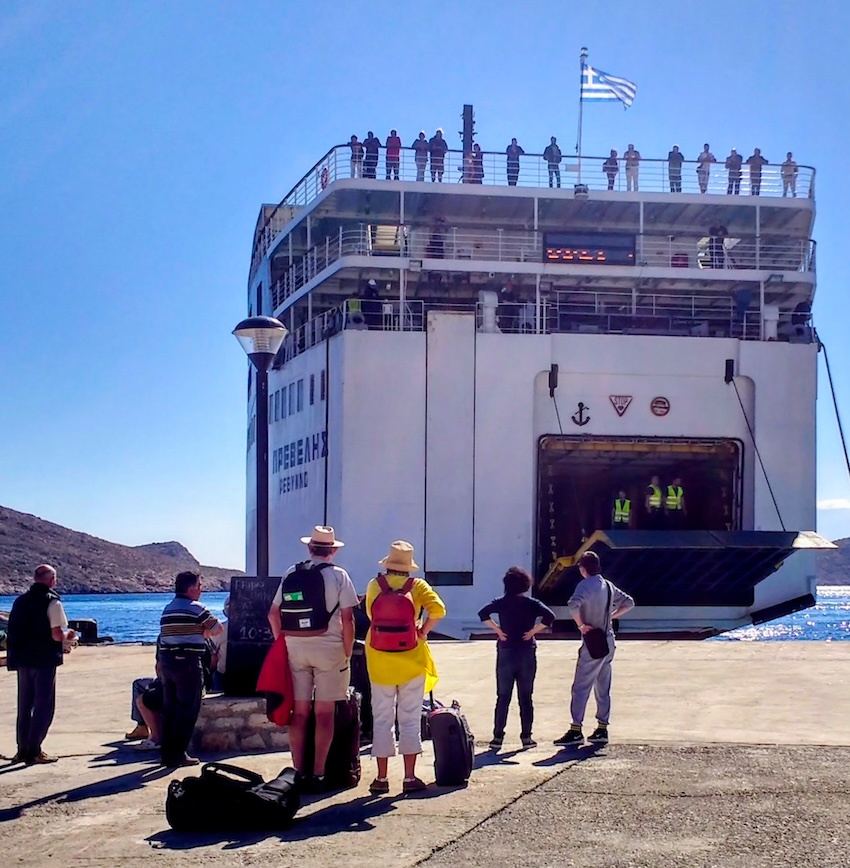
Getting to and from HalkiHalki is accessible by boat only. The island’s own ferry - the passenger-only Aegean Gem - provides frequent daily sailings to and from Kamiros Skala on Rhodes, while other ferries provide twice-weekly sailings from Rhodes Town, stopping on Halki enroute to other Dodecanese islands or to Piraeus. As the point of entry into Greece for most visitors to Halki is Rhodes airport, the most well trod route to Halki is a bus or taxi from Rhodes airport to Kameros Skala, an hour north of the airport. For those wishing to depart from Rhodes Town, the Dodecanisos Seaways operates two return sailings a week from Kolona harbour to Halki, Tilos, Nisyros, Kos and Kalymnos. A larger car ferry, the Saos ferry, also stops in Halki twice a week on its loop through the Dodecanese islands from Akandia harbour. Other island-hopping opportunities are facilitated by the Anek/Blue Star ferries which stop into Halki twice a week, either enroute to Piraeus via Sitia and Heraklion on Crete or via Analfi and Santorini. You may want to keep this in mind even just to marvel of seeing these large overnight ferries arrive on a small island at nightfall. Brobdingnagian in scale, they overwhelm Emborio’s boutique harbour, their brightly lit decks merging with an already incandescent nightscape. Truly the quintessential Greek island experience! You can find and book most ferries at Ferryhopper |
 |
|
Written by J. Kathleen Thompson, a freelance writer and incurable enthusiast for adventure, music, the extraordinary in the everyday, and liberal amounts of Greek sunshine and yogurt. When not on a bike or boat in the Mediterranean, she calls Canada home. Visit her blog at justgojo.com Thank you to Seren Ariella and Phaedra Clarke for their invaluable insights, and contributions to this travel review |
 Use Ferryhopper to find all direct and indirect ferry routes for the islands of Greece, Spain, Italy &
Turkey, compare ferry companies & prices, and book cheap ferry tickets with no hidden fees in one go!
Use Ferryhopper to find all direct and indirect ferry routes for the islands of Greece, Spain, Italy &
Turkey, compare ferry companies & prices, and book cheap ferry tickets with no hidden fees in one go!



Join Matt Barrett's Greece Travel Guides Group on Facebook for comments, photos and other fun stuff. If you enjoy this website please share it with your friends on Facebook. If you are appreciative of all the free information you get on my websites you can send a donation through Paypal or you can use Venmo
