|
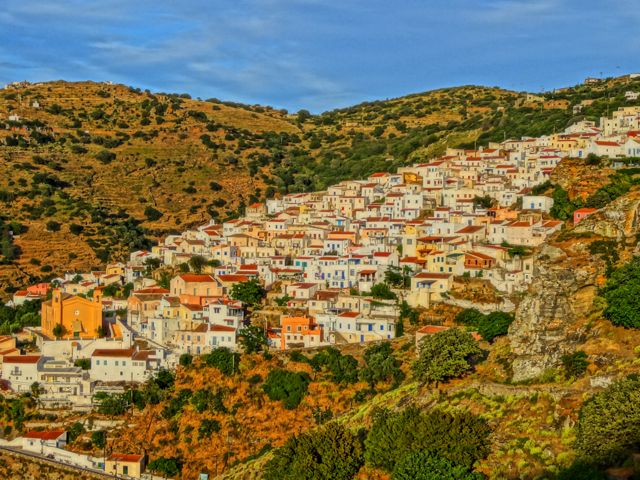 To call Kea's main village of Ioulis 'unspoiled'
is not entirely accurate. It is spoiled in a way.
Kea was discovered by the artist Fasianos and he
paved the way for an army of artists who followed
him here. Then one of Greece's many millionaires
built a house on the island which of course caused
all the other Greek millionaires to want one here
as well. This got the attention of anyone in
Athens who had money to spend on an island house
only two hours away from Greece's capital. In that
sense it became like an Hydra for yuppies and
middle-class Athenians who flood the island in the
summer and warm weekends. Except in Hydra you
can't build any more houses and in Kea entire
neighborhoods are springing up on barren pieces of
property. But in Ioulis where you can only restore
and people must leave their cars at the entrance
of the town, life is pretty much the way it has
always been. So while on other islands you have to
be vigilant and prepared to jump out of the way of
speeding motorcycles piloted by sunburned
tourists, in this main town in the center of the
island you are safe and can relax. However you
need to be alert so you don't get knocked over by
the occasional passing donkey on one of the narrow
back streets. Since the village is mostly made up
of steps, all building material has to be brought
up by donkeys and there is always some
construction going on though with everything done
by hand you probably won't hear it. To call Kea's main village of Ioulis 'unspoiled'
is not entirely accurate. It is spoiled in a way.
Kea was discovered by the artist Fasianos and he
paved the way for an army of artists who followed
him here. Then one of Greece's many millionaires
built a house on the island which of course caused
all the other Greek millionaires to want one here
as well. This got the attention of anyone in
Athens who had money to spend on an island house
only two hours away from Greece's capital. In that
sense it became like an Hydra for yuppies and
middle-class Athenians who flood the island in the
summer and warm weekends. Except in Hydra you
can't build any more houses and in Kea entire
neighborhoods are springing up on barren pieces of
property. But in Ioulis where you can only restore
and people must leave their cars at the entrance
of the town, life is pretty much the way it has
always been. So while on other islands you have to
be vigilant and prepared to jump out of the way of
speeding motorcycles piloted by sunburned
tourists, in this main town in the center of the
island you are safe and can relax. However you
need to be alert so you don't get knocked over by
the occasional passing donkey on one of the narrow
back streets. Since the village is mostly made up
of steps, all building material has to be brought
up by donkeys and there is always some
construction going on though with everything done
by hand you probably won't hear it.
|
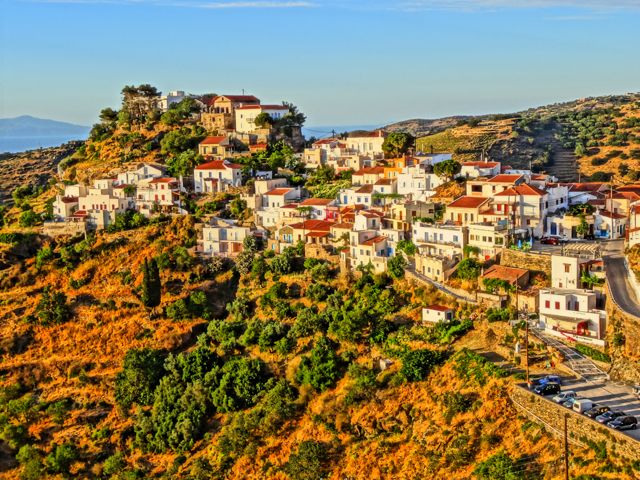
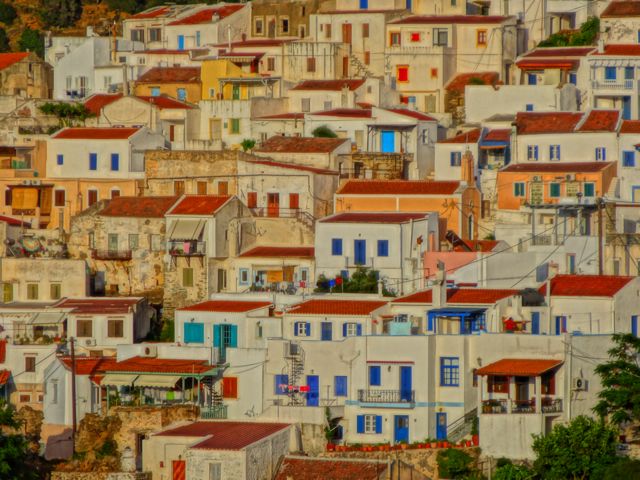 The town is really pretty spectacular and looks
like a Pueblo village sitting on the
slope of a couple mountains. You can wander around
the streets and alleyways for hours and become
completely lost in the jumble of streets and
steps, or you can hang out in the relative
security of several village squares, each one with
restaurants and cafes, peopled by locals and
Athenians and the occasional ambitious tourist on
his way to see the smiling Lion. The influx of
Athenian yuppies has its downside of course but on
the bright side you can now get a pretty decent
cappuccino at several cafes in the village which
for some members of my household is necessary for
survival. As the island becomes more popular I
expect more cafes and restaurants will open up as
people with ties to the island or visitors who
fall in love with the island realize the potential
and come up with a plan to secure their own
survival. The town is really pretty spectacular and looks
like a Pueblo village sitting on the
slope of a couple mountains. You can wander around
the streets and alleyways for hours and become
completely lost in the jumble of streets and
steps, or you can hang out in the relative
security of several village squares, each one with
restaurants and cafes, peopled by locals and
Athenians and the occasional ambitious tourist on
his way to see the smiling Lion. The influx of
Athenian yuppies has its downside of course but on
the bright side you can now get a pretty decent
cappuccino at several cafes in the village which
for some members of my household is necessary for
survival. As the island becomes more popular I
expect more cafes and restaurants will open up as
people with ties to the island or visitors who
fall in love with the island realize the potential
and come up with a plan to secure their own
survival.
|
|
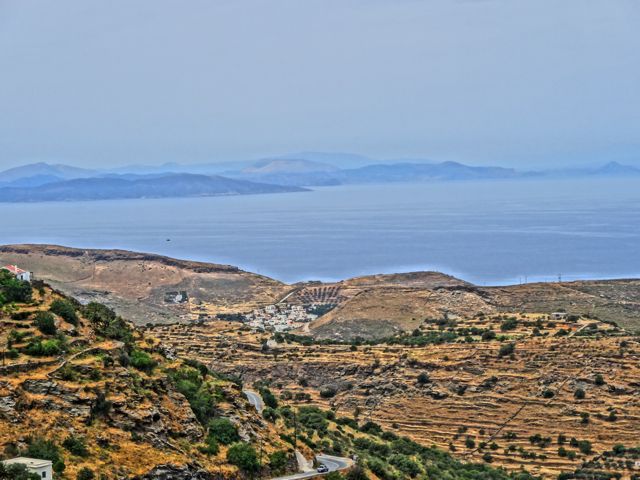 When you arrive in Ioulis the bus or taxi drops
you off at the first square outside the gate of
the town. Well it is more of a parking lot for the
taxis and buses than a square but there is a cafe there and it is a great place to
watch the sun set over the Cava d Oro the body of water that separates Kea from Attika and Athens. It is the
resting place of the Britannic, the sister-ship of
the Titanic which sank on a bright sunny day
during WW.I when it hit a mine while serving as a
hospital ship. This was the subject of a pretty
bad made-for-TV movie that I was not quite able to
get through despite my fascination with the
subject. But if you can forget that this first
platia is a parking lot (easy to do because only
the bus and taxis park here and they are always
busy) and order a sandwich, drink or a snack from the Coolpan,
you can take a picture as nice as this one or better. There
is also a small clinic here, an excellent butcher, and even a tourist shop. If you think of Ioullis as a
walled fortress city, which it is in a way, this
is the entrance. If you have a vehicle, unless you
are delivering something, you can go no further
and even if you are, unless you are a very
talented driver there is not much chance of you making it through the narrow passageway.
When you arrive in Ioulis the bus or taxi drops
you off at the first square outside the gate of
the town. Well it is more of a parking lot for the
taxis and buses than a square but there is a cafe there and it is a great place to
watch the sun set over the Cava d Oro the body of water that separates Kea from Attika and Athens. It is the
resting place of the Britannic, the sister-ship of
the Titanic which sank on a bright sunny day
during WW.I when it hit a mine while serving as a
hospital ship. This was the subject of a pretty
bad made-for-TV movie that I was not quite able to
get through despite my fascination with the
subject. But if you can forget that this first
platia is a parking lot (easy to do because only
the bus and taxis park here and they are always
busy) and order a sandwich, drink or a snack from the Coolpan,
you can take a picture as nice as this one or better. There
is also a small clinic here, an excellent butcher, and even a tourist shop. If you think of Ioullis as a
walled fortress city, which it is in a way, this
is the entrance. If you have a vehicle, unless you
are delivering something, you can go no further
and even if you are, unless you are a very
talented driver there is not much chance of you making it through the narrow passageway.
There is a spot for handicapped parking in the square. Otherwise leaving your car here is risky as is parking on the road between the community health center and the piatsa.
|
|
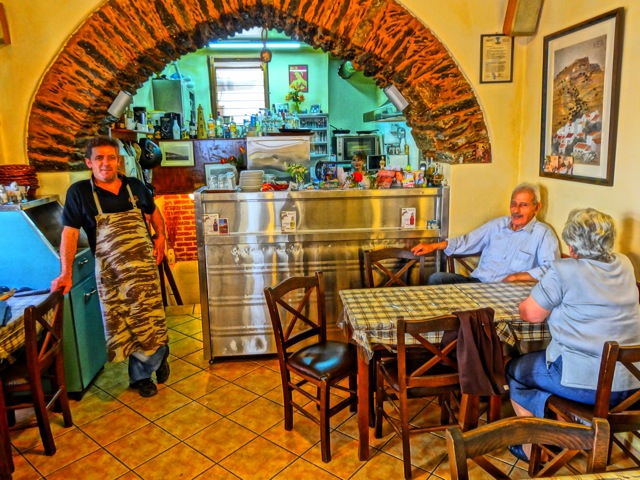 When you walk through the archway you may not notice the small shops inside the passageway, but you should stop for a moment and walk into the tiny store called Tyrakeion.gr which is a small shop selling local milk products like cheese, and especially their delicious home made Gelato, sheep and goat yogurt and rizogalo
(rice pudding). As you enter the village you come to the
small square known as the Piatsa and there is a
small restaurant here which serves good food which
is also called The Piatsa. The
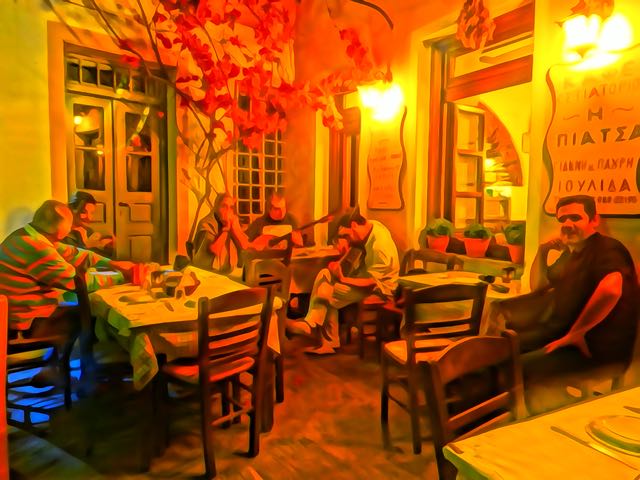
Piatsa Restaurant, also known as Yannis in the Piatsa, not to be confused with Yannis in the Platia (more on that later). Though
small, this is a great place to eat lunch or dinner if you want to eat the traditional island cuisine. Especially good (excellent
actually) is their arni lemonato (lamb cooked in
lemon) and their moscari kokinisto (beef in tomato sauce).
Great spaghetti too in case you have kids who have
not embraced Greek cooking yet. Yannis is the
owner, a terrific cook, and he makes the best cheese omelets and strapatsa (like scrambled eggs with cheese and tomato) I have
ever eaten. In the off-season this is the coziest place on the island to have a nice meal and drink a little tsipuro and a couple liters of wine to pass the day. When you walk through the archway you may not notice the small shops inside the passageway, but you should stop for a moment and walk into the tiny store called Tyrakeion.gr which is a small shop selling local milk products like cheese, and especially their delicious home made Gelato, sheep and goat yogurt and rizogalo
(rice pudding). As you enter the village you come to the
small square known as the Piatsa and there is a
small restaurant here which serves good food which
is also called The Piatsa. The
Piatsa Restaurant, also known as Yannis in the Piatsa, not to be confused with Yannis in the Platia (more on that later). Though
small, this is a great place to eat lunch or dinner if you want to eat the traditional island cuisine. Especially good (excellent
actually) is their arni lemonato (lamb cooked in
lemon) and their moscari kokinisto (beef in tomato sauce).
Great spaghetti too in case you have kids who have
not embraced Greek cooking yet. Yannis is the
owner, a terrific cook, and he makes the best cheese omelets and strapatsa (like scrambled eggs with cheese and tomato) I have
ever eaten. In the off-season this is the coziest place on the island to have a nice meal and drink a little tsipuro and a couple liters of wine to pass the day.
|
|
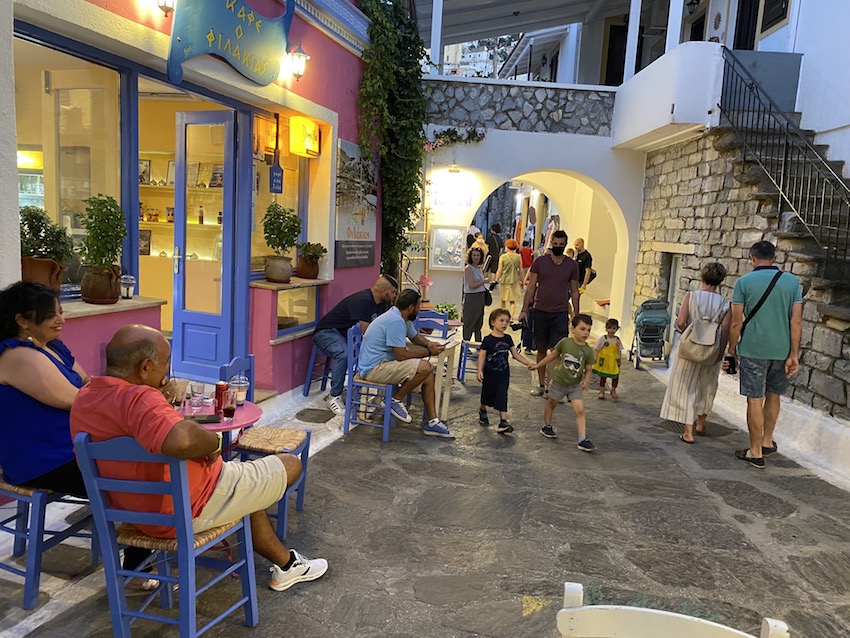 Also in the same little square is the small Cafe Filakias, which is owned by Giannis' brother where you can get tiropitas, snacks, coffee, ice-cream, beer and maybe the best cocktails on the island. Though it is not the kind of place you would expect to find cocktails the covid lock-down forced them to improvise and since one of
the sons was a talented bartender on Kea, with no bars to work at, he started making them for takeout. So after your trip to the lion on your way out of town you can stop here for a cocktail and maybe an ice-cream for the kids to keep them quiet and allow you to enjoy your drink. It is a fun place to watch and see who comes and goes through the entrance to the village. (Actually since they started doing the cocktails I never see the people from the lower village come up to our part of the village). There
is also a
Pandapoleio
which is a
store that sells everything owned by Maria who
speaks excellent English as well as several gift shops in the stegadi, the covered passageway that is the entrance to the village. Also in the same little square is the small Cafe Filakias, which is owned by Giannis' brother where you can get tiropitas, snacks, coffee, ice-cream, beer and maybe the best cocktails on the island. Though it is not the kind of place you would expect to find cocktails the covid lock-down forced them to improvise and since one of
the sons was a talented bartender on Kea, with no bars to work at, he started making them for takeout. So after your trip to the lion on your way out of town you can stop here for a cocktail and maybe an ice-cream for the kids to keep them quiet and allow you to enjoy your drink. It is a fun place to watch and see who comes and goes through the entrance to the village. (Actually since they started doing the cocktails I never see the people from the lower village come up to our part of the village). There
is also a
Pandapoleio
which is a
store that sells everything owned by Maria who
speaks excellent English as well as several gift shops in the stegadi, the covered passageway that is the entrance to the village.
|
 If you go towards your left you will come to the
Kastro of the town, the oldest section with the
ancient fortifications and acropolis and the
remains of the Venetian wall. This was most likely
the site of the temple to Apollo. Further below in
the area which was once the ancient agora there
are seats carved in stone and the chuch of Agia
Paraskevis built inside a cave. There is also an old
hotel on the rock with a restaurant and amazing
views but it has been closed for years and who
knows if it will ever re-open. The story is that
it was owned by an old couple who rarely answered
their phones or took reservations and finally left
owing the town millions of drachma in back rent.
If you are planning to stay in Ioulis this would
be the place to be and hopefully one day it will be a hotel again. Like any high
point in the village the views are spectacular
whether you are looking across the island to the
mainland or at the rest of the village on the
adjoining hillside. This former hotel now serves as the temporary elementary school. If my elementary school had such a view I would have been an even worse student as unimaginable as that may sound to my former teachers. Strangely enough some of the most popular guidebooks still list this hotel though it has been closed for at least 15 years! If you go towards your left you will come to the
Kastro of the town, the oldest section with the
ancient fortifications and acropolis and the
remains of the Venetian wall. This was most likely
the site of the temple to Apollo. Further below in
the area which was once the ancient agora there
are seats carved in stone and the chuch of Agia
Paraskevis built inside a cave. There is also an old
hotel on the rock with a restaurant and amazing
views but it has been closed for years and who
knows if it will ever re-open. The story is that
it was owned by an old couple who rarely answered
their phones or took reservations and finally left
owing the town millions of drachma in back rent.
If you are planning to stay in Ioulis this would
be the place to be and hopefully one day it will be a hotel again. Like any high
point in the village the views are spectacular
whether you are looking across the island to the
mainland or at the rest of the village on the
adjoining hillside. This former hotel now serves as the temporary elementary school. If my elementary school had such a view I would have been an even worse student as unimaginable as that may sound to my former teachers. Strangely enough some of the most popular guidebooks still list this hotel though it has been closed for at least 15 years! |
|
If you back past the Piatsa instead and walk
through the archway and up the main street youwill pass Savina Ceramics on your right, the excellent Abourkouna Wine Bar on your left and the Archaeological Museum on
your right, one of the best in the Cyclades. As you continue past the old post office, now the Ioulis House Cafe, is the Gustosa Trattoria, an Italian restaurant featuring pizzas, pastas, salads, deserts and a beautiful rooftop terrace with a view of the entire village.
|
|
 Next is a very nice little cafe
called the En Lefko where you can sit in a
beautiful shaded patio beneath the ancient walls
of the city and drink
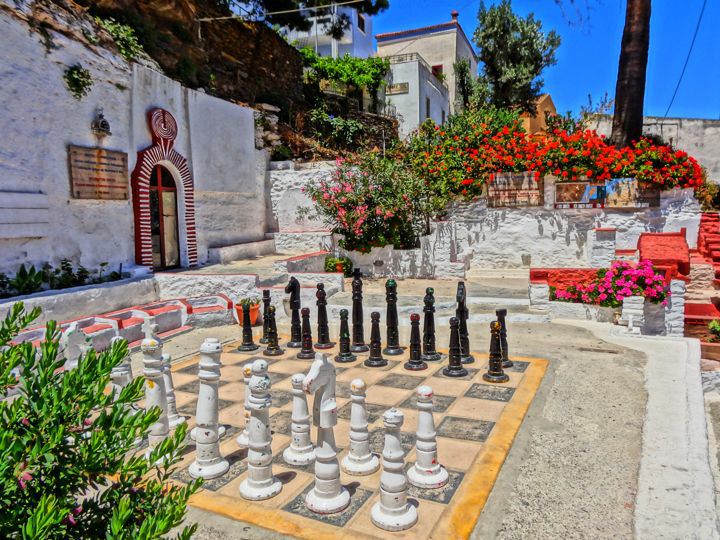
espresso or watch your children play chess in Platia Delapizza with pieces as tall as they are. If you are here for the World Cup or the European Cup or any major sporting event they have a very large TV outside. To see the ancient walls walk through the cafe and out the back door and down the stairs and you will feel like you are in a tree-house in a jungle. You can't miss the massive walls of ancient Ioulida, one of the oldest towns which has been continuously inhabited
since ancient times. Right next door is Stella, a really nice little boutique that is worth a visit owned by my friend Yannis and his wife Stella. They also have a shop in the back streets of Korissia. Next is a very nice little cafe
called the En Lefko where you can sit in a
beautiful shaded patio beneath the ancient walls
of the city and drink
espresso or watch your children play chess in Platia Delapizza with pieces as tall as they are. If you are here for the World Cup or the European Cup or any major sporting event they have a very large TV outside. To see the ancient walls walk through the cafe and out the back door and down the stairs and you will feel like you are in a tree-house in a jungle. You can't miss the massive walls of ancient Ioulida, one of the oldest towns which has been continuously inhabited
since ancient times. Right next door is Stella, a really nice little boutique that is worth a visit owned by my friend Yannis and his wife Stella. They also have a shop in the back streets of Korissia.
|
|
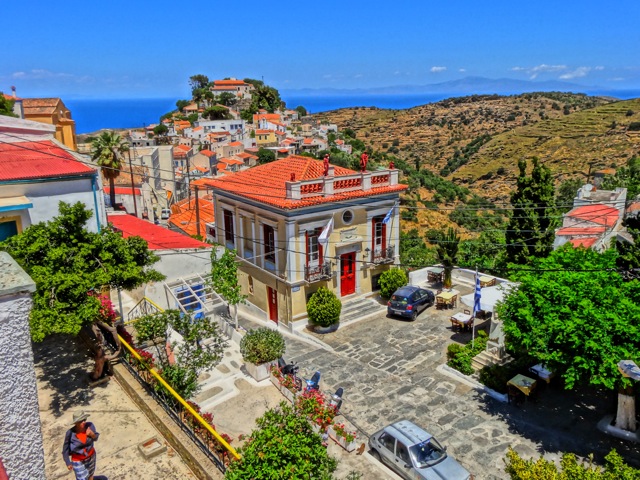 The
former demarchio (town hall) building in the main square is one of
the most interesting neo-classic buildings in the
Greek islands, designed by the architect Ernestos Tsiller, who also designed the school and some of the most well known 19th century buildings in Greece. It was built by my wife's great
grandfather Gregoris Jeromnimon in 1902. He built
many of the fountains in and around the village
and the large house he built which overlooks the
Cavo d Oro is where we stay. He also built all the
schools, the three main cathedrals and some of the
smaller churches as well. He was mayor for over
forty years and died on a couch in the old
cafeneon which used to share the building. On the
roof of the building are two clay statues, one of
Apollo and the other of Hermes and inside the
building are some artifacts from ancient Karthea. The
former demarchio (town hall) building in the main square is one of
the most interesting neo-classic buildings in the
Greek islands, designed by the architect Ernestos Tsiller, who also designed the school and some of the most well known 19th century buildings in Greece. It was built by my wife's great
grandfather Gregoris Jeromnimon in 1902. He built
many of the fountains in and around the village
and the large house he built which overlooks the
Cavo d Oro is where we stay. He also built all the
schools, the three main cathedrals and some of the
smaller churches as well. He was mayor for over
forty years and died on a couch in the old
cafeneon which used to share the building. On the
roof of the building are two clay statues, one of
Apollo and the other of Hermes and inside the
building are some artifacts from ancient Karthea.
|
|
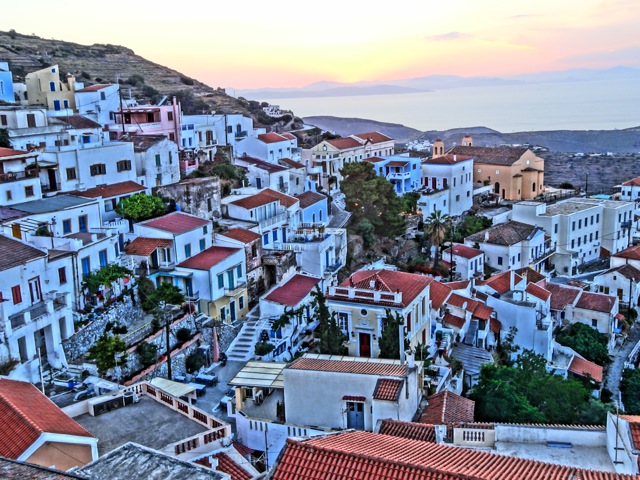 The town surrounds the square like a big
amphitheater and just like at Epidavros where you
can hear a coin drop on the stage from the top row
of seats, in Ioulis you can hear anything that
goes on in the square, even a violin played
through a PA system at four o'clock in the morning.
On Sundays the square is full of pick-up trucks
because the farmers come in with their produce
since they know that the villagers will all be
around for church and socializing. On Saturday
night the restaurants are full and children use
the square to play while their parents eat and
drink and enjoy the air of the village which is
much cooler than the ports. The main square is where they hold the festivals
and the weddings. Antonakis Zoulos,
one of the finest violin players in Greece is the
main performer at every event. Weddings in Kea can
go on for days and nights with endless singing,
playing and dancing. The celebration of the
Panagia on August 15th is another night of food,
wine, music and dancing. Ask in the town hall when
the next wedding or panagiri is scheduled because
if you are lucky enough to be there you will hear
one of the most amazing musicians in Greece. I
have been laying in my bed at 5 am while a
celebration was still going on in the square below
listening in total awe and hearing every note
played by the legendary Zoulos. (For more on
Antonakis Zoulos including some audio-video clips
of him performing
click
here.) The town surrounds the square like a big
amphitheater and just like at Epidavros where you
can hear a coin drop on the stage from the top row
of seats, in Ioulis you can hear anything that
goes on in the square, even a violin played
through a PA system at four o'clock in the morning.
On Sundays the square is full of pick-up trucks
because the farmers come in with their produce
since they know that the villagers will all be
around for church and socializing. On Saturday
night the restaurants are full and children use
the square to play while their parents eat and
drink and enjoy the air of the village which is
much cooler than the ports. The main square is where they hold the festivals
and the weddings. Antonakis Zoulos,
one of the finest violin players in Greece is the
main performer at every event. Weddings in Kea can
go on for days and nights with endless singing,
playing and dancing. The celebration of the
Panagia on August 15th is another night of food,
wine, music and dancing. Ask in the town hall when
the next wedding or panagiri is scheduled because
if you are lucky enough to be there you will hear
one of the most amazing musicians in Greece. I
have been laying in my bed at 5 am while a
celebration was still going on in the square below
listening in total awe and hearing every note
played by the legendary Zoulos. (For more on
Antonakis Zoulos including some audio-video clips
of him performing
click
here.)
|
|
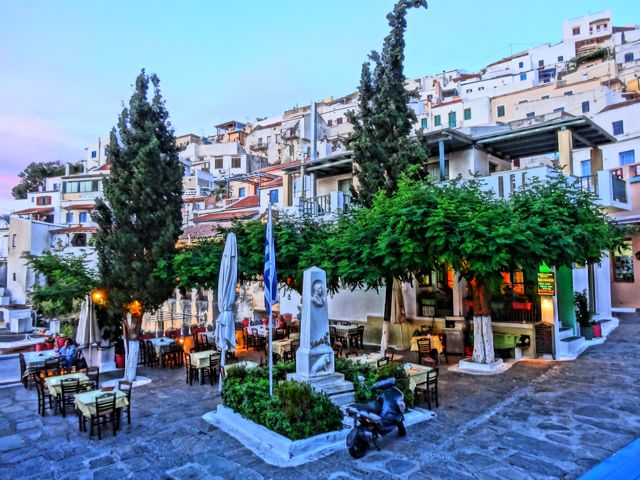 As you walk through the square there is a taverna
on your left called 'Yiannis' also known as the 'Oinozythestiatoriaon
Kalofagadon' though of course nobody would waste their time calling it that. Its just Yannis in the Platia, (not to be confused with Yannis in the Piazza.) This is where I also spend a lot of time
especially when the grill is fired up or a whole
roast pig is turning on the spit. His main waiter is Frangisco, one of my young pals who gets plenty of help from Panayotis Coolpan and Vangelis and also Yiannis, who all speak English. The restaurant is owned by Big Yannis, the former bus driver and one of the finest cooks on the island, the God of the Grill in my opinion. This is the place
to be, especially on Saturday night when they roast
the pig on a spit. Order a kilo of that for you and your friends and a plate of kontosouvli as a starter and you may never want to leave the island. If you don't come early on Saturday you
may not get a table. I used to drink the
white wine but I mixed it with soda so I am not too
drunk when the food arrives. Now I prefer his red which is local, made by Big Yiannis actually, and better, and I don't even care if it is stronger too. If you come on a
weeknight
they serve the best paidaikia (lambchops) and if you are lucky they will have provatina which is paidakia but older and if done well, as Yiannis does, the best meat dish you will have ever eaten. You can
also have a good steak here too, made with local beef, and the dishes
that are cooked in the oven are also excellent,
particularly their dolmades (stuffed grape
leaves), their stuffed kolokithea (zucchini), gemista (stuffed tomatoes and peppers) and the roast lamb and potatoes. Also well worth eating at any time of day are his pitas... mushroom, spinach and kolokithia. My latest discovery is his katsiki lemonato (goat in lemon sauce) and his dolmades, probably the best on the island. Try the paspala, a local dish sort of like scrambled eggs with tomatoes and pork, similar to the strapatsada served at Yiannis in the Piatsa.
Don't leave without desert and a tsipuro. As you walk through the square there is a taverna
on your left called 'Yiannis' also known as the 'Oinozythestiatoriaon
Kalofagadon' though of course nobody would waste their time calling it that. Its just Yannis in the Platia, (not to be confused with Yannis in the Piazza.) This is where I also spend a lot of time
especially when the grill is fired up or a whole
roast pig is turning on the spit. His main waiter is Frangisco, one of my young pals who gets plenty of help from Panayotis Coolpan and Vangelis and also Yiannis, who all speak English. The restaurant is owned by Big Yannis, the former bus driver and one of the finest cooks on the island, the God of the Grill in my opinion. This is the place
to be, especially on Saturday night when they roast
the pig on a spit. Order a kilo of that for you and your friends and a plate of kontosouvli as a starter and you may never want to leave the island. If you don't come early on Saturday you
may not get a table. I used to drink the
white wine but I mixed it with soda so I am not too
drunk when the food arrives. Now I prefer his red which is local, made by Big Yiannis actually, and better, and I don't even care if it is stronger too. If you come on a
weeknight
they serve the best paidaikia (lambchops) and if you are lucky they will have provatina which is paidakia but older and if done well, as Yiannis does, the best meat dish you will have ever eaten. You can
also have a good steak here too, made with local beef, and the dishes
that are cooked in the oven are also excellent,
particularly their dolmades (stuffed grape
leaves), their stuffed kolokithea (zucchini), gemista (stuffed tomatoes and peppers) and the roast lamb and potatoes. Also well worth eating at any time of day are his pitas... mushroom, spinach and kolokithia. My latest discovery is his katsiki lemonato (goat in lemon sauce) and his dolmades, probably the best on the island. Try the paspala, a local dish sort of like scrambled eggs with tomatoes and pork, similar to the strapatsada served at Yiannis in the Piatsa.
Don't leave without desert and a tsipuro.
|
|
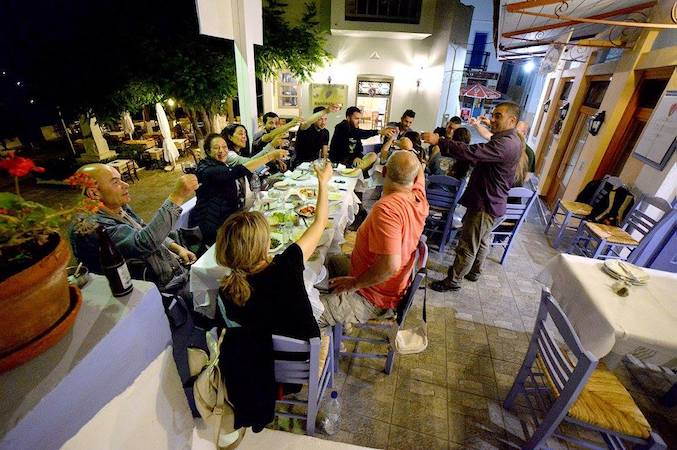 In my opinion some of the best food on the island was found
at Rolando's, the ouzerie-taverna across the street
from Yiannis restaurant, and I should know, having eaten there about a hundred times in the last three years. Unfortunately for me, Rolando left Ioulida to open a new restaurant in the port and sold it to his friend Andonis (Cyclades Anton to his Facebook friends) and he has done a fine job and has introduced some new dishes while keeping many of the favorite dishes of Rolando's customers. The new restaurant is called O Paparounas and opened in June of 2017. He has added fried barbounia
(red mullet), gavros marinato (fresh marinated anchovies), lakerda pastes(salted
bonito) and some veal, pork and beef steaks as well as the famous sausage of Kea and excellent mousaka. We still manage to eat here a couple nights a week and it is a fun place with good food and
lots of neighborly conversation when you are lucky enough to find a table on the terrace. I highly recommend their beef with eggplant, a sort of Ottoman dish, similar to what we were eating in Istanbul. Also his tirokafteri, spicy cheese spread made with jalapeno peppers. Also their local grilled sausage is recommended. Sharing this side of the platia with Paparounas is the cocktail bar called BArLCOLNEY or something like that. The young guys who work there are friendly and know how to make a good
drink. Their music caters to a younger crowd but the plan is to play music for old people like me until around 11pm and then switch over.
In my opinion some of the best food on the island was found
at Rolando's, the ouzerie-taverna across the street
from Yiannis restaurant, and I should know, having eaten there about a hundred times in the last three years. Unfortunately for me, Rolando left Ioulida to open a new restaurant in the port and sold it to his friend Andonis (Cyclades Anton to his Facebook friends) and he has done a fine job and has introduced some new dishes while keeping many of the favorite dishes of Rolando's customers. The new restaurant is called O Paparounas and opened in June of 2017. He has added fried barbounia
(red mullet), gavros marinato (fresh marinated anchovies), lakerda pastes(salted
bonito) and some veal, pork and beef steaks as well as the famous sausage of Kea and excellent mousaka. We still manage to eat here a couple nights a week and it is a fun place with good food and
lots of neighborly conversation when you are lucky enough to find a table on the terrace. I highly recommend their beef with eggplant, a sort of Ottoman dish, similar to what we were eating in Istanbul. Also his tirokafteri, spicy cheese spread made with jalapeno peppers. Also their local grilled sausage is recommended. Sharing this side of the platia with Paparounas is the cocktail bar called BArLCOLNEY or something like that. The young guys who work there are friendly and know how to make a good
drink. Their music caters to a younger crowd but the plan is to play music for old people like me until around 11pm and then switch over.
|
|
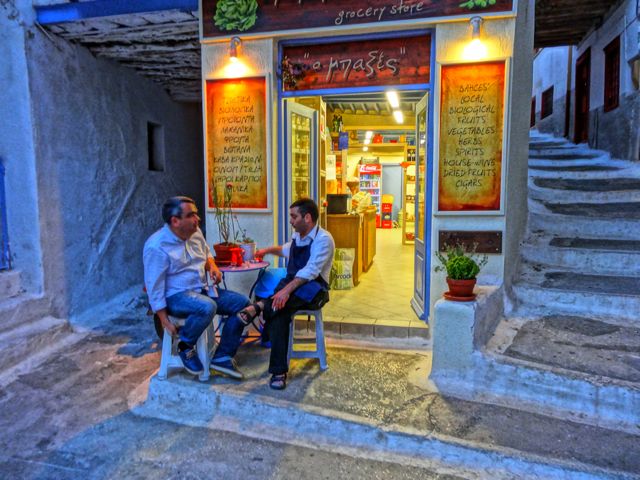 The best thing to happen to Ioulida since the arrival of Rolando has to be the opening of the Bakshe, a sort of epicurian grocery store that has a large selection of fresh fruits and vegetables, all sorts of nuts and herbs and spices, a large selection of wines from all over Greece as well as the local wines bottled by
the farmers like Kostis at Red Tractor and Giorgo Paouris who both make excellent reds. Run by a woman named Toni, the shop is a far cry from the old vegetable shop that seemed as if it was run by a woman who did not like vegetables. She also owned the computer shop but had her 90 year old mother working there and she did not know anything about computers or cash registers for that matter and whenever I
wanted to buy something she never knew would it cost and would tell me to come back when her daughter was there and I would come back and the daughter was never there and finally they went out of business. So now we have a really good fresh grocery market and I would rather have no computer store than a bad one. The best thing to happen to Ioulida since the arrival of Rolando has to be the opening of the Bakshe, a sort of epicurian grocery store that has a large selection of fresh fruits and vegetables, all sorts of nuts and herbs and spices, a large selection of wines from all over Greece as well as the local wines bottled by
the farmers like Kostis at Red Tractor and Giorgo Paouris who both make excellent reds. Run by a woman named Toni, the shop is a far cry from the old vegetable shop that seemed as if it was run by a woman who did not like vegetables. She also owned the computer shop but had her 90 year old mother working there and she did not know anything about computers or cash registers for that matter and whenever I
wanted to buy something she never knew would it cost and would tell me to come back when her daughter was there and I would come back and the daughter was never there and finally they went out of business. So now we have a really good fresh grocery market and I would rather have no computer store than a bad one.
|
|
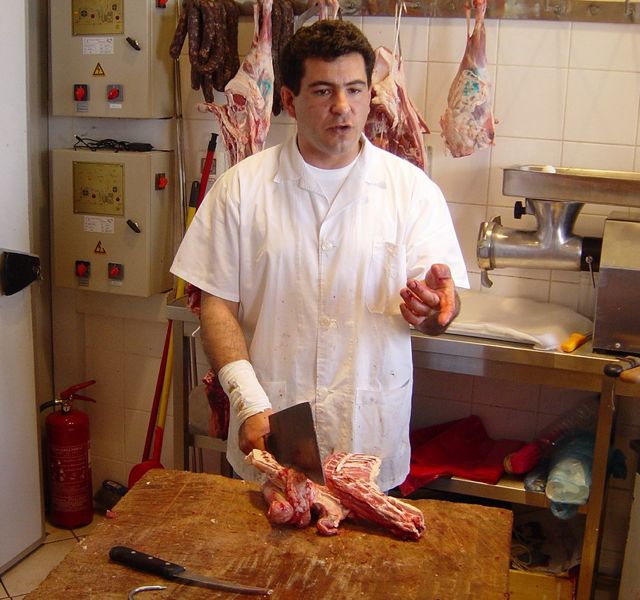 Diagonally across is the supermarket-butcher owned by Mr Tassos and Kyria Anna and their beautiful daughter, Irini who is an actress. The son Giorgos was one of the most colorful characters of the village but he died in a car accident several years ago. His photo is mounted in the butcher section of the shop. This shop really
is a Super-market. There are actual real supermarkets on the island that are the size of the supermarkets you may be used to. This supermarket has the same stuff crammed into about one tenth the space and also includes a butcher shop and a cheese shop. It is worth going in just to marvel at their organizational skills. If you are renting a house or living in Ioulida then this shop is essential for daily necessities. They also sell many canned and bottled traditional foods from the island and all the
meat is local. Their freezers are full of fish, even octopus and barbouni. By the way the other supermarket in the Piazza, which I mentioned before, is like going back
in time. You should visit on the way in or out of town. Maria, the owner speaks English and has kept the place looking very traditional, as an island supermarket should be. Diagonally across is the supermarket-butcher owned by Mr Tassos and Kyria Anna and their beautiful daughter, Irini who is an actress. The son Giorgos was one of the most colorful characters of the village but he died in a car accident several years ago. His photo is mounted in the butcher section of the shop. This shop really
is a Super-market. There are actual real supermarkets on the island that are the size of the supermarkets you may be used to. This supermarket has the same stuff crammed into about one tenth the space and also includes a butcher shop and a cheese shop. It is worth going in just to marvel at their organizational skills. If you are renting a house or living in Ioulida then this shop is essential for daily necessities. They also sell many canned and bottled traditional foods from the island and all the
meat is local. Their freezers are full of fish, even octopus and barbouni. By the way the other supermarket in the Piazza, which I mentioned before, is like going back
in time. You should visit on the way in or out of town. Maria, the owner speaks English and has kept the place looking very traditional, as an island supermarket should be.
|
|
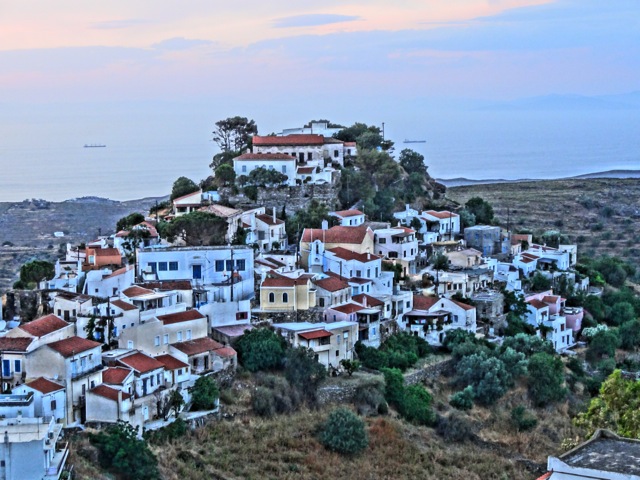 If you take a left at the top of the platia there are 2 very nice shops which feature clothing and art. One is called Stefania and the other is called In-Kea and worth stopping in before dinner, after lunch or on your way to the lion. If you continue on and
walk through the archway and up the steps you will
see on your left the Mikro Parisi
which has a balcony that overlooks the whole
village and all of Attika and serves breakfast, excellent deserts and coffee, your favorite beverages
and is the last stop for many of the villagers
after a night out in the tavernas. It is also
jumping on Sunday after church. It could possibly be
the best place to watch the sunset outside of
Santorini. As you continue
up the steps you will pass Epiloges, a small gift shop, and Metallon, a silver jewelry workshop. You will emerge from the center of the
village and find yourself on the road with the
village on your left and an expansive view on your
right. This area, believe it or not is where all the
nightlife of the island used to be. Most people
hang out at the Leon Bar which is a gem of a place and a good reason to come to Ioulida. If you want to try Greek micro-brew beers they have several and the bartenders are known for their excellent cocktails. Next door is a wonderful little family run taverna called To Steki, that is a favorite of the locals and X-pats and worth the walk.
If you take a left at the top of the platia there are 2 very nice shops which feature clothing and art. One is called Stefania and the other is called In-Kea and worth stopping in before dinner, after lunch or on your way to the lion. If you continue on and
walk through the archway and up the steps you will
see on your left the Mikro Parisi
which has a balcony that overlooks the whole
village and all of Attika and serves breakfast, excellent deserts and coffee, your favorite beverages
and is the last stop for many of the villagers
after a night out in the tavernas. It is also
jumping on Sunday after church. It could possibly be
the best place to watch the sunset outside of
Santorini. As you continue
up the steps you will pass Epiloges, a small gift shop, and Metallon, a silver jewelry workshop. You will emerge from the center of the
village and find yourself on the road with the
village on your left and an expansive view on your
right. This area, believe it or not is where all the
nightlife of the island used to be. Most people
hang out at the Leon Bar which is a gem of a place and a good reason to come to Ioulida. If you want to try Greek micro-brew beers they have several and the bartenders are known for their excellent cocktails. Next door is a wonderful little family run taverna called To Steki, that is a favorite of the locals and X-pats and worth the walk.
|
|
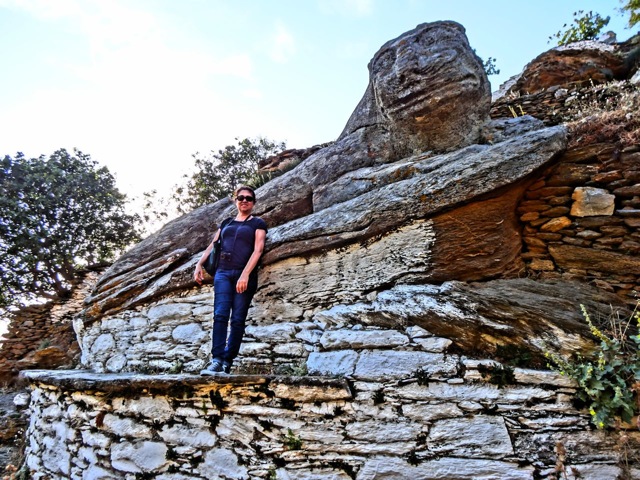 By continuing along the road you will pass the
Cathedral of Agios Spyridon and at the end of the
village you will find yourself on the old stone
road that takes you past the spring of Kounderis.
The whole area is very green with olives and fig
trees as well as fields on the terraced
mountainside. A little past the cemetery and a
small whitewashed church is the Lion of Kea, a
huge statue carved out of granite from the 6th
century BC. This is the journey that most foreign
travelers take and well worth the walk which is
level and quite easy to make on the old road. Not
much is known about the Lion and why he is
smiling, but they say in the old days Lions used
to roam the hills and valleys which were at one
time covered in trees. Beyond the lion is yet
another spring, this one called the Spring of
Benjamin, with it's troughs for the animals and
marble columns. The path continues on to Otzias if
you are the type who loves walking. In fact the
walking is great in Kea since much of the old road
network still exist as do the footpaths which go
all over the island. They are numbered on the map
and many have signposts that tell you the distance
in minutes from the next village.
By continuing along the road you will pass the
Cathedral of Agios Spyridon and at the end of the
village you will find yourself on the old stone
road that takes you past the spring of Kounderis.
The whole area is very green with olives and fig
trees as well as fields on the terraced
mountainside. A little past the cemetery and a
small whitewashed church is the Lion of Kea, a
huge statue carved out of granite from the 6th
century BC. This is the journey that most foreign
travelers take and well worth the walk which is
level and quite easy to make on the old road. Not
much is known about the Lion and why he is
smiling, but they say in the old days Lions used
to roam the hills and valleys which were at one
time covered in trees. Beyond the lion is yet
another spring, this one called the Spring of
Benjamin, with it's troughs for the animals and
marble columns. The path continues on to Otzias if
you are the type who loves walking. In fact the
walking is great in Kea since much of the old road
network still exist as do the footpaths which go
all over the island. They are numbered on the map
and many have signposts that tell you the distance
in minutes from the next village.
|
|
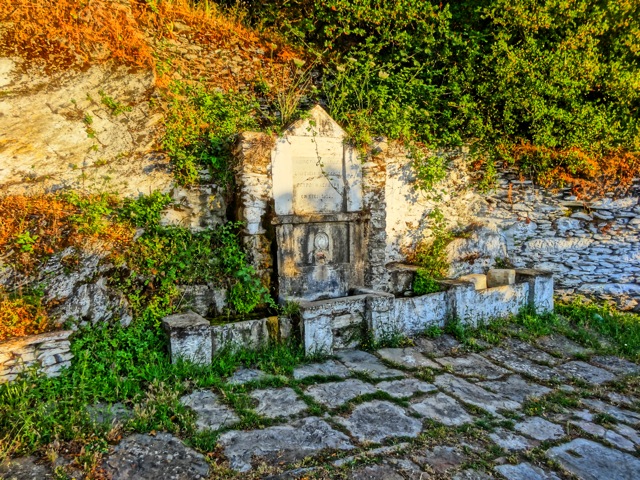 There are several ancient springs in and
around the town and these are now the
fountains you see where man and beast both
drink from. The water is quite pure and better
than any bottled spring water you will find on
your dinner table. It is most likely because
of these springs that the town was built here
in the first place. The biggest is just below
the entrance of the town and is called the
Spring of Rokomenos. The spring of Kourendis
on the road to the lion is considered to be
the best tasting of them all. It is not
uncommon to come upon a herd of sheep, horses
or cows drinking at these fountains on the
outskirts of the village though you need no
worry about disease since they use the the
tubs where the spring water runs off and the
humans use the spring itself. These springs
and fountains also attract butterflies, dragon
flies and an occasional bee or two since one
of the main products of Kea is honey. Kea is
also known for the quality of it's milk and
cheese as well as the excellent quality of
it's pork. The animals are kept far from town
in the terraced fields and on Sunday after
church the farmers who come into town to hang
out wth their friends in the cafes can create
quite a commotion. The best cafeneon in the
village which was in the back part of the town
hall has closed, but in the years past you
could hear the farmers in the cafe, talking,
drinking and singing sometimes even being
joined by the village priest. Now they hang
out at Yannis, drinking enough to make driving
their pickups back down through the village an
adventure.
There are several ancient springs in and
around the town and these are now the
fountains you see where man and beast both
drink from. The water is quite pure and better
than any bottled spring water you will find on
your dinner table. It is most likely because
of these springs that the town was built here
in the first place. The biggest is just below
the entrance of the town and is called the
Spring of Rokomenos. The spring of Kourendis
on the road to the lion is considered to be
the best tasting of them all. It is not
uncommon to come upon a herd of sheep, horses
or cows drinking at these fountains on the
outskirts of the village though you need no
worry about disease since they use the the
tubs where the spring water runs off and the
humans use the spring itself. These springs
and fountains also attract butterflies, dragon
flies and an occasional bee or two since one
of the main products of Kea is honey. Kea is
also known for the quality of it's milk and
cheese as well as the excellent quality of
it's pork. The animals are kept far from town
in the terraced fields and on Sunday after
church the farmers who come into town to hang
out wth their friends in the cafes can create
quite a commotion. The best cafeneon in the
village which was in the back part of the town
hall has closed, but in the years past you
could hear the farmers in the cafe, talking,
drinking and singing sometimes even being
joined by the village priest. Now they hang
out at Yannis, drinking enough to make driving
their pickups back down through the village an
adventure.
|
|
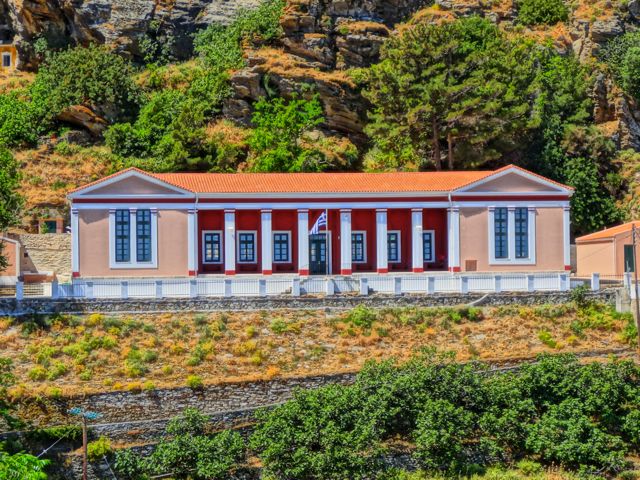 Just above the Rokomeno Health Center, near the
Piatsa entrance of the village and the parking lot where everyone
leaves their cars, is the old school, which is
now the town hall of Kea. The building was built
by Andrea's great grandfather in the
neo-classic style and is considered to be one
of the most elegant examples of this type of school building in Greece. Behind the old school-new town hall is the remains of the old outdoor movie theater which used to open in July and show movies nightly until the end of August but it was so windy and cold up there they had to move the theater down to Livadi. There is a small spring right behind the building and you can follow the path in front of it to Tria Pigadia spring and some of the farms in the area, notably those owned by Mavromakis, the charismatic
butcher who keeps his cows, sheep and goats up here and can sometimes
be seen herding them down the path towards the slaughterhouse.
Just above the Rokomeno Health Center, near the
Piatsa entrance of the village and the parking lot where everyone
leaves their cars, is the old school, which is
now the town hall of Kea. The building was built
by Andrea's great grandfather in the
neo-classic style and is considered to be one
of the most elegant examples of this type of school building in Greece. Behind the old school-new town hall is the remains of the old outdoor movie theater which used to open in July and show movies nightly until the end of August but it was so windy and cold up there they had to move the theater down to Livadi. There is a small spring right behind the building and you can follow the path in front of it to Tria Pigadia spring and some of the farms in the area, notably those owned by Mavromakis, the charismatic
butcher who keeps his cows, sheep and goats up here and can sometimes
be seen herding them down the path towards the slaughterhouse.
|
|
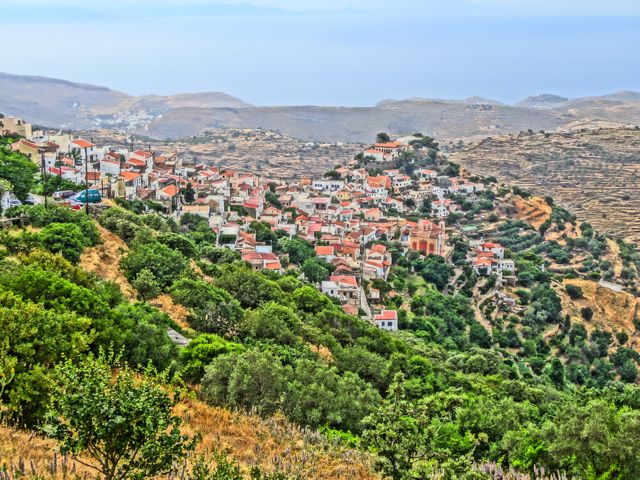 Because there are no hotels in the village
most tourists come up during the day. But there
are plenty of taxis and buses in the summer so
a nightime visit for dinner is possible if not
preferable. The best thing to do is time it so that you get here about 7pm and walk through the village to the lion and then come back, have a drink or an ouzo and meze and then have dinner at one of the restaurants here. They will arrange for a taxi to pick you up in the piazza when you are ready to leave. If you want to stay in the village Kea Villas at the top of the village are an option
though walking home after a big meal at Rolando's may have
you wishing you had found something closer. Still you can always take a taxi to the top of the village and if you have a car it is actually a convenient place for getting most anywhere on the island and the view is amazing. You can find more houses and holiday homes in Hora using Booking.com's Ioulida Kea page. Be sure you look at the map to see the location of the property because sometimes houses way out in the
country are listed as being in the village. Because there are no hotels in the village
most tourists come up during the day. But there
are plenty of taxis and buses in the summer so
a nightime visit for dinner is possible if not
preferable. The best thing to do is time it so that you get here about 7pm and walk through the village to the lion and then come back, have a drink or an ouzo and meze and then have dinner at one of the restaurants here. They will arrange for a taxi to pick you up in the piazza when you are ready to leave. If you want to stay in the village Kea Villas at the top of the village are an option
though walking home after a big meal at Rolando's may have
you wishing you had found something closer. Still you can always take a taxi to the top of the village and if you have a car it is actually a convenient place for getting most anywhere on the island and the view is amazing. You can find more houses and holiday homes in Hora using Booking.com's Ioulida Kea page. Be sure you look at the map to see the location of the property because sometimes houses way out in the
country are listed as being in the village.
|
|
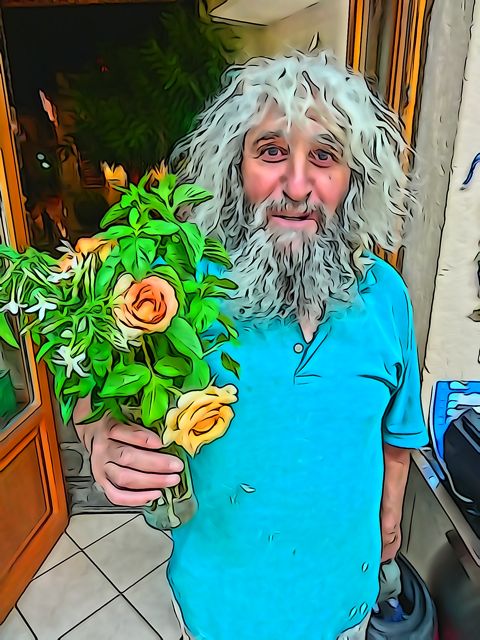 Ioulis
is also the home of the painter Del (or
Dellapizza) who may be the heart and soul of
the village. He is the one who used to keep the
streets clean, white-washes the walls and
steps, frees the ancient pathways from years
of over-growth and kept all the plants and
trees healthy. The reason Ioulida looks so
beautiful is because of Dellapizza and one day
there will be a statue of him in the platia.
He is also a wonderful artist whose work is an
amazing look into the personalities and
politics of the island. During the summer of 2007 Dellapizza decided to fix up the abandoned lot that had stood for several years after they tore down the building that used to house the butcher and the electric shop. For weeks he worked to create this beautiful and colorful garden and platia which he used to show an exhibit of his paintings on August 15th. It now has an almost life-sized chess-set where you can actually play by lifing up the giant pieces and moving them around the
board. It will give you a whole new perspective on the game of chess. Del's studio was a cave carved into the wall by his garden. (They say
that because Ioulis sits on top of the ancient
city you can get from the top of the village
to the very bottom through underground caves
and passageways.) Unfortunately with the cutbacks due to the economic crisis Del lost his job and his pension. But he can still be seen around the village on his way to and from various tasks. Be sure to visit the Gallery of DEL by following the signs on the way out of town going towards the ancient Lion of Kea. There is a small church on the right just past the Leon Bar and and if you turn right and walk up and to the right
you should find it. All his work is displayed there and he has postcards and prints that he gives away. Please offer him money and when he turns
you down insist he takes it. If he still is reluctant just leave it somewhere he will find it after you leave. Ioulis
is also the home of the painter Del (or
Dellapizza) who may be the heart and soul of
the village. He is the one who used to keep the
streets clean, white-washes the walls and
steps, frees the ancient pathways from years
of over-growth and kept all the plants and
trees healthy. The reason Ioulida looks so
beautiful is because of Dellapizza and one day
there will be a statue of him in the platia.
He is also a wonderful artist whose work is an
amazing look into the personalities and
politics of the island. During the summer of 2007 Dellapizza decided to fix up the abandoned lot that had stood for several years after they tore down the building that used to house the butcher and the electric shop. For weeks he worked to create this beautiful and colorful garden and platia which he used to show an exhibit of his paintings on August 15th. It now has an almost life-sized chess-set where you can actually play by lifing up the giant pieces and moving them around the
board. It will give you a whole new perspective on the game of chess. Del's studio was a cave carved into the wall by his garden. (They say
that because Ioulis sits on top of the ancient
city you can get from the top of the village
to the very bottom through underground caves
and passageways.) Unfortunately with the cutbacks due to the economic crisis Del lost his job and his pension. But he can still be seen around the village on his way to and from various tasks. Be sure to visit the Gallery of DEL by following the signs on the way out of town going towards the ancient Lion of Kea. There is a small church on the right just past the Leon Bar and and if you turn right and walk up and to the right
you should find it. All his work is displayed there and he has postcards and prints that he gives away. Please offer him money and when he turns
you down insist he takes it. If he still is reluctant just leave it somewhere he will find it after you leave.
For more about Dellapizza see
The Art of Dellapizza.
|
|
Nightlife
 Ioulida used to be the center of the island nightlife with a line of bars going from the church of Agios Spiridon to the edge of town along the road to the Lion. The most successful of the bars was The Leon which was the last to close several years ago. However in 2014 they reopened and once again Ioulida has some nightlife
that is not centered around eating. It is a cozy little stone building, very nicely decorated with tables and chairs outside where you can see the lights of Attika twinkling in the distance. The young owners have good taste in music of all time periods and you may even hear The Kinks and other British bands of the sixties echoing through the mountains. They also have air-conditioning and I have been told by more than one person that they make the World's Best Bloody Mary. According to my party age daughter
this is now the place to be and in August expect the fun to go on until the sun comes up. For beer lovers they have the island's best selection of micro-brew beers. A few steps further is 49 Steps, a bar that must have cost a million euros to build, that lasted one year and then closed. It has returned in the past as others have tried their luck in making money there. The Cafe En Lefko also has drinks, music, snacks and is good for people watching in the summer,
and for watching popular sporting events like the World Cup. In the Piazza where the taxis and buses turn around is a psistaria called H Thea Kea which also has drinks, a terrific view, ouzo snacks, pizza and music. On Friday, Saturday and Sunday nights Yannis' Piatsa restaurant has live rembetika music. You can get cocktails next door, some say the best on the island, at Filakias Cafe, and listen to the music if there is no room at the restaurant. Or you can sit
out back and still hear the music with a view of the village. Also there is the newly opened Barlcony in the platia. Ioulida used to be the center of the island nightlife with a line of bars going from the church of Agios Spiridon to the edge of town along the road to the Lion. The most successful of the bars was The Leon which was the last to close several years ago. However in 2014 they reopened and once again Ioulida has some nightlife
that is not centered around eating. It is a cozy little stone building, very nicely decorated with tables and chairs outside where you can see the lights of Attika twinkling in the distance. The young owners have good taste in music of all time periods and you may even hear The Kinks and other British bands of the sixties echoing through the mountains. They also have air-conditioning and I have been told by more than one person that they make the World's Best Bloody Mary. According to my party age daughter
this is now the place to be and in August expect the fun to go on until the sun comes up. For beer lovers they have the island's best selection of micro-brew beers. A few steps further is 49 Steps, a bar that must have cost a million euros to build, that lasted one year and then closed. It has returned in the past as others have tried their luck in making money there. The Cafe En Lefko also has drinks, music, snacks and is good for people watching in the summer,
and for watching popular sporting events like the World Cup. In the Piazza where the taxis and buses turn around is a psistaria called H Thea Kea which also has drinks, a terrific view, ouzo snacks, pizza and music. On Friday, Saturday and Sunday nights Yannis' Piatsa restaurant has live rembetika music. You can get cocktails next door, some say the best on the island, at Filakias Cafe, and listen to the music if there is no room at the restaurant. Or you can sit
out back and still hear the music with a view of the village. Also there is the newly opened Barlcony in the platia.
See Ioulida Map (opens in a new page)
|
|