Greek Islands
A Guide to Spetses
A Guide to Spetses
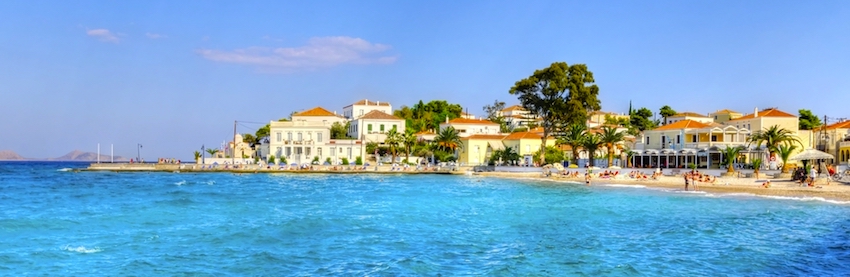
SpetsesBy Diana Farr Louis I find it hard to write about Spetses. I’ve known it too long, loved it too well. We have both changed unalterably since I landed there in 1963, intending to stay a week but seduced – not by any man – into spending two months. And most of every summer after that for the next seven years. Yes, eventually, there was a man. And now our family has a house on the hill above the Old Harbor, so we go there often, but not in July or August if we can possibly avoid it. Off season I still recognize the island I first knew. The crowds of flashy Athenians and their spoiled progeny vanish except on certain weekends, the motorbike traffic drops to bearable, the overpriced boutiques close, removing their casually elegant temptations from my view, and life settles back to its naturally indolent pace. I realize I’ve become a curmudgeon, resentful of the “progress” that slowly strangled what we old timers call the Golden Age of Greece – the 60s and early 70s – the era before mass tourism, television and conspicuous consumption. |
 |
|
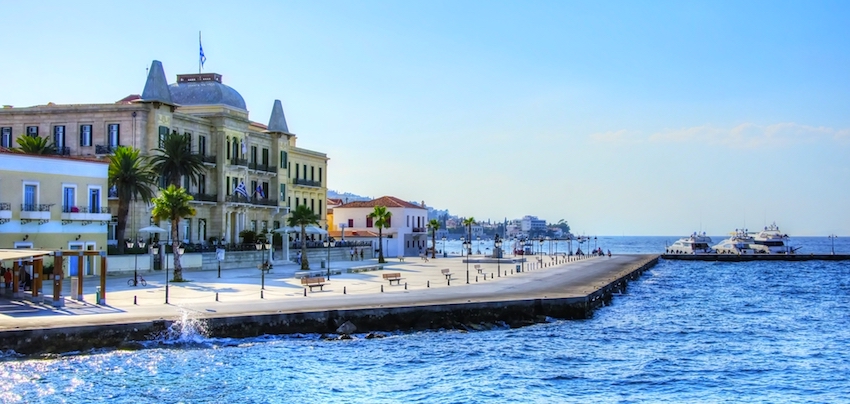
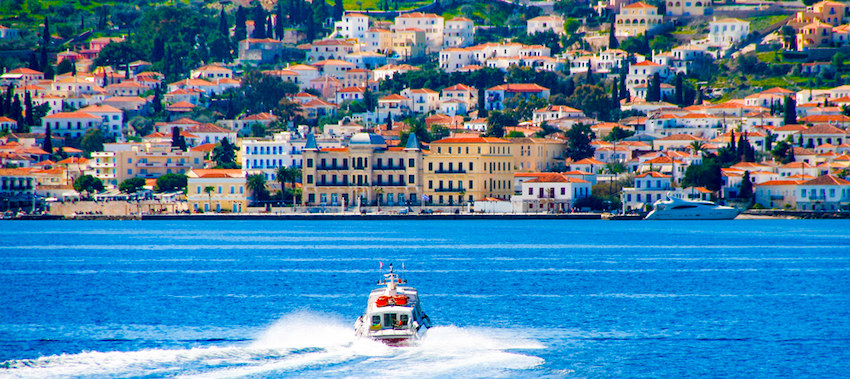
Spetses is both cursed and blessed by its assets; being too pretty and too accessible have made it too popular. The last of the Argo-Saronic islands that include Aigina, Poros and Hydra off the northeast coast of the Peloponnesos, Spetses was so green in antiquity that it was called Pityoussa – covered with pines. Cruel winds rarely buffet it, yet every midday in summer a delicious breeze springs up to cool it. Although it has to import water, bougainvillea, hibiscus, plumbago, jasmine and trumpet vines thrive in the mild climate, spangling white walls with pink, mauve, red, baby blue and orange petals. Handsome mansions dominate the seafront between the Old Harbor (Paliolimani) and ∏-shaped Dapia, where sea taxis and kaikis huddle under cannons left from the War of Independence. Adjoining the modern jetty, where the hydrofoils dock, stands an ochre elephant of a hotel – the grand Posidonion Hotel, where Athenian gentry holidayed a century ago. They would sip tea and play cards on its broad terraces, but when they went to swim, revealing shockingly bare ankles and shoulders, they risked finding the beach strewn with sea urchins, a token of the locals’ displeasure. Or so said my mother-in-law. By the time I knew it, Spetses was recovering from the post-war slump and only too happy to welcome Athenians and tourists in bikinis. Both Greeks and foreigners were buying up the wonderful old houses that date back to the 18th and 19th century when the island was a shipping force. Hard to believe, but this itty bitty island (22 sq km) and its neighbor Hydra both made fortunes trading under the Ottomans. And in 1821, at the outbreak of Revolution, they had no qualms about arming their merchantmen and mounting raids against the imperial super power. It’s still a matter of immense pride and many a myth that the fleets of Spetses and Hydra, along with Psara (near Chios, which still bears the scars of Turkish wrath), supplied the bulk of the instant Greek navy. They fought the Turks for another eight years before finally gaining Independence (with a little help from the British, French and Russians). For the rest of the century, Spetses continued to prosper. In my bedroom there’s a fuzzy photo of the Old Harbor crammed with tall-masted sailing ships. But by the end of it, steam engines made Spetses irrelevant. Nevertheless, it has remained one of the very few places in Greece where traditional kaikis are built. And you can see their skeletal hulls, ribs painted orange, sandwiched incongruously between the restaurants and bars deep inside the Old Harbor. |
|
|
|
Spetses is easy to get to know, superficially at least. Its only town, with about 5,000 permanent residents, stretches along the north coast from the Old Harbor, considered the classiest district, to Dapia, the port, and west to Kounoupitsa, with its more modest houses. It doesn’t take much more than half an hour to walk from one end to the other, but nobody would be caught dead using their feet in Spetses. The locals, young and ancient, male and female, are latter-day centaurs, almost welded to their motorbikes. Sometimes whole families of four or five squeeze onto one, while I’ve seen the most improbable things being carried. Most memorable was the guy wearing a canoe on his head, driving with one hand, holding it with the other, barely able to see as he bounced along a patch of stony road. A visit to Spetses begins as you step off the hydrofoil at Dapia, which means “fortified place” in Turkish or Albanian, depending on who tells you. Today, it’s the center of Spetses life, where you go to buy the newspaper (foreign or Greek), do some shopping (for essentials or extravagances) and, most of all, just hang out. The cafés behind the cannon are filled day and night with non-locals nursing frappes or scoffing excellent sweets, while old timers and Spetsiotis patronize Stambolis on the upper left side. Below it are a small Alpha Bank branch, the Flying Dolphin ticket office, a well-stocked periptero (kiosk) and a gleaming new café – so new I’ve never sat there, but it looks pricey. |
|
|
|
A stone’s throw to the left, the mansion built by Sotirios Anargyros at the turn of the last century hints at another story. Like so many Greeks, he left for the US penniless and returned a millionaire. You can see from its overly ornate façade and rather important size that he wanted everyone to know about it. But he poured money into the island, too. Not only did he build the luxurious Posidonion Hotel, he founded an elite boarding school (at the edge of Kounoupitsa) and organized a reforestation campaign to replace the pines that had been cut for firewood and masts. Generations of boys whose families worked in Africa, the Middle East and even Athens hated the English type discipline but got an excellent education. In the 1950s, its most illustrious teacher, John Fowles, wrote his best seller The Magus there and launched Spetses into a literary limelight not matched until Corelli’s Mandolin drew readers (and then moviegoers) to Kefallonia in the 90s. The school closed some years ago, the hotel has been renovated and is up and runningand the forest is a patchwork of mixed growth, having been the target of arsonists and the occasional spark from the garbage dump several times. Meanwhile, Anargyros’s stately home looks demure and understated compared to some of the pretensiosities rising ever higher above the town. |
Food and Nightlife |
|
|
|
Behind the cafés, though, two entertainment meccas – the island’s outdoor cinemas – remain unchanged. We used to howl at their spaghetti westerns and classical epics whose heroes dived off the Parthenon into the sea, before heading off to Blueberry Hill (near the school) to dance under the stars. Alas, open-air discos don’t exist any more, and I’m not the right person to advise about nightlife. But Spetses has a reputation of being a party island, so seek and ye shall find. There are bars and clubs all along the waterfront and concentrated in the Old Harbor and Baltiza (inner harbor). The younger members of our family prefer the Spetsa Bar at Agios Mamas. Naturally, there are any number of places to eat. Kids head for the square with the clock tower – where I have never sat – for pizza and souvlaki. Fish fanatics may opt for grilled octopus without frills at the Fish Market near Dapia or Patralis on the water at Kounoupitsa. The latter is fancier but a good place to splurge because the food and service are always excellent. Traditional home cooking and fish are available every day of the year at Roussos Taverna near Agios Mamas, the town beach. You can choose your dish from the stew pots and baking pans behind the counter and the prices are reasonable. |
|
In the Paliolimani, we always used to go for an ouzo at Kapeloyiannis’s tables on the dock and follow up with dinner next door at Sioras’s Exedra. At these places, where the elite meet, you can be sure to see friends, eat well and pay handsomely for the pleasure of sitting right on the water. A more moderately priced eatery in the Old Harbor, just before the road curves into the Baltiza/inner yacht harbor, is the aptly named Kalakathoumena, an expression which means "out of the blue" but taken literally could mean "sitting well". Good food, very agreeable owners. Following the road into the Baltiza, there are several options we like, depending on the mood and pocket book: Nektarios’s taverna, on the water, for simple, economical dishes; and Costa’s Pizzeria, an institution, on the right side of the road. Costa lived in Italy for years and knows how pizzas should taste and how to keep people coming back for more, year after year. Continuing on the road all the way around the Baltiza, usually jammed with yachts three-deep in summer and the odd fishing kaiki, will bring you to the promontory with the lighthouse at its tip. Take a look at the karnayio/shipyard at the entrance and then explore the headland. More than a great place to escape bikes and people, especially in the early evening, it is also an open-air sculpture museum scattered with highly imaginative animals crafted by Natalia Mela out of unlikely materials. Nata, a well known Athenian sculptor who made Spetses her summer home, is in her 80s and still producing delightful work from found objects like chains, rakes, tools and sheepbells. Besides her goats and bulls are a mermaid on the shore, a freedom fighter under the lighthouse and, on the new jetty near the Posidonion, a statue of Bouboulina. |
|
James Foot on Food and Wine in Spetses...
"Tarsanas is in Palio Limani and is an uber-wonderful seafood restaurant, this and Orloff' (not the hotel/the restaurant) have seriously good wine lists from all over Greece. The latter does a sort of contemporary take on Greek cuisine and anyone who is anyone goes there. (They queue for tables) The tuna carpaccio and the black ink risotto are fabulous. Patralis is at the other end of the town - an old, established restaurant but is still very good for fish. Of the bars Balkoni does champagne cocktails and the Dapia has the incomparable Stambolis' Kafeneion. There's also a good Greek Taverna for lunch called Boubalina's(!!) in the fish market which does the regular things well. The Poseidonion Hotel has a very shishy bar-restaurant and main restaurant, has food events and a fabulous wine list. Be sure to visit the two art galleries near Dapia, Kapopoulos and Galerie Nord. And Bar Spetsa remains the best 60s/70s music bar in Greece!" For more information about his work see jamesfootwatercolours.com |
Spetses Beaches |
 |
|
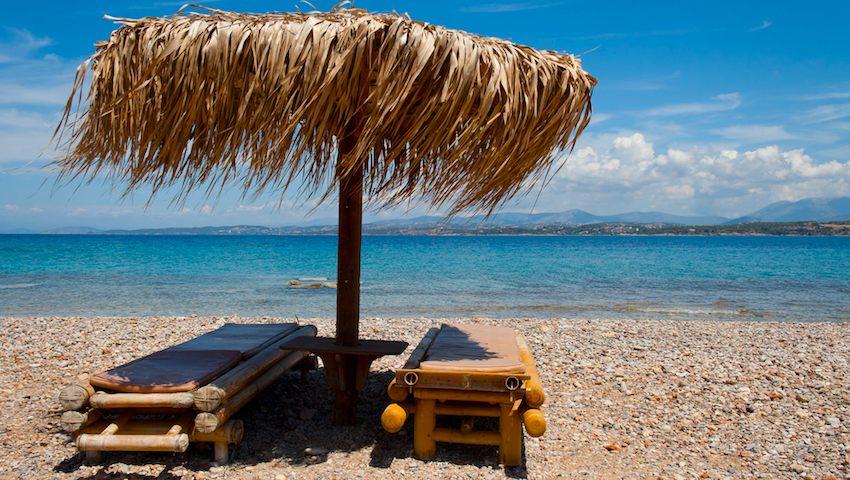
But what about swimming? Spetses has the kind of beaches I like: more little coves hemmed by rocks than great expanses of fine sand. Snorkeling can be psychedelic thanks to the entrancing pink and mauve patterns on the walls of small caves, while at Agii Anargyri, the island’s biggest beach, you can swim into a large cave where women and children allegedly hid during at least one Ottoman raid. The story goes that their wily menfolk placed fezzes on the asphodels that grow by the hundreds near the lighthouse and frightened the enemy away. By now all the larger beaches are equipped with sunbeds, brollies and tavernas. Closest to town is Agia Marina, which faces the Niarchos family’s island of Spetsopoula, acquired by papa Stavros after his archrival Ari Onassis bought Skorpios in the Ionian. The beach here is a bit stony but I love it in the morning before the wind chops its glassy surface into waves. Until eleven, it’s practically empty except for the oldsters enjoying their daily gossip as they tread water in the shallows with their hats on. If you’re feeling flush, have a drink or lunch at Paradisos behind the beach. Otherwise, Tzortzis on the right offers the same view for much less (and a less exciting but adequate menu). |
|
Heading round the island – by bus, kaiki, or sea taxi if you haven’t rented wheels – omitting the smaller coves, you come to Xilokeriza (once my favorite before the houses were built), Agii Anargyri and Agia Paraskevi. This last had no taverna in our day and we saved it for special occasions – all day picnics and evening lamb roasts. The pines are much diminished since the last fire two-three years ago and the once scarily isolated house above the beach, said to be where the Magus lived, stands exposed and bereft of fantasy. The pines have re-seeded themselves though, so one hopes they will be allowed to grow. Zogeria, the final biggish bay, faces north. It has always had a taverna and is popular with yachts. Between it and Kounoupitsa/Dapia are a few idyllic coves where pines still reach the water’s edge and cyclamen bloom with the first autumn rains. For a dip, it’s perfectly okay to swim from any of the town beaches. When feeling lazy, I often go to the sliver of beach below Agios Nikolaos, the monastery overlooking the Old Harbor. If you’re wearing something more respectable than a bathing suit, stop in the courtyard to admire a Spetses trademark – mosaic paving using smooth black and white pebbles. Every old house and some new have them with their own characteristic symbols, but these are open to public view. The monastery itself dates from the 18th century and Napoleon’s brother is alleged to have slept there. It’s definitely worth a look and infinitely more attractive than the unfinished, out of scale monstrosity the Church has seen fit to erect next door. Which sends me into paroxysms of un-Christian rage every time I see it looming above the charming two-story houses in its vicinity. By now you should know whether Spetses will be your cup of tea or rather mug of beer. Of course, I still love it – in the way one still has feelings for an old flame who held such promise but who let himself go astray. You who have no memories may still be delighted by the intimacy of a small place, by the liveliness of its evening-to-dawn scene, by walks up the “mountain” to see the views or walks along the back streets to catch a glimpse of aristocratic houses hidden behind thick white walls. Or simply the mad thrill of charging around on a motorbike with a host of other beautiful young men and women. |
Getting Around Spetses |
 |
|
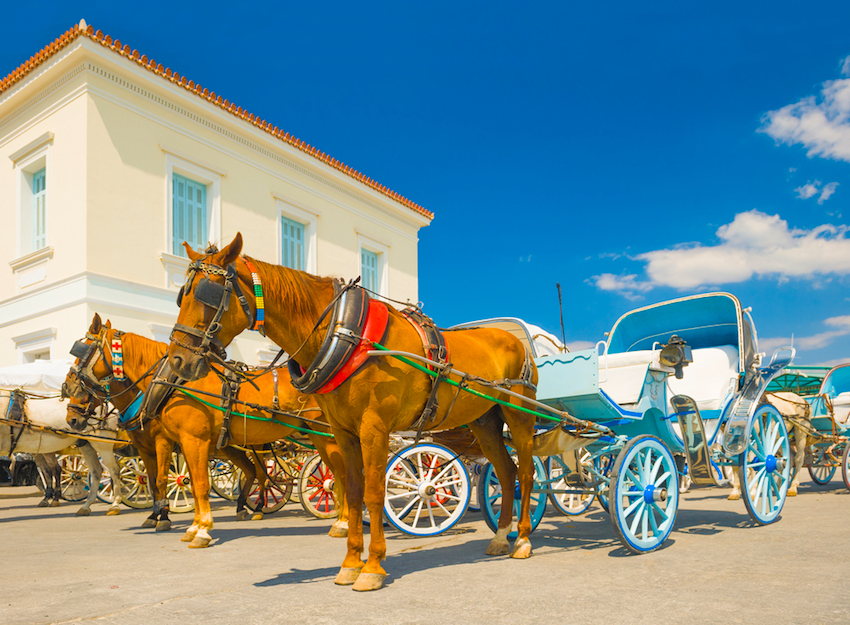
Dapia is the island’s transportation hub. Sea taxis and kaikis bob below the cafés. Besides taking you singly or in a group to the beaches round the island, they’ll also carry you to beaches across the straits on the Peloponnesos, starting with Kosta, which is served by an unglamorous ferry as well. Be warned: the sea taxis areexpensive – 20 euros to or from Kosta – while the ferry has got to be the cheapest fare in Greece at 80 lepta (cents)! Kosta, a few miles east of Porto Heli, has a decent beach, but we drive from Athens and park the car there – cars are prohibited on Spetses from Easter to the end of October. And so do a lot of regular visitors and islanders, who balk at paying the 35 euros for a one way ticket on the hydrofoil from Piraeus. Sadly, the more economical boat that took five hours was discontinued a couple of summers ago and there are no plans to reinstate it. There’s a taxi rank at Dapia – for all six cabs – and in the square behind it stand the island’s fleet of horse-drawn buggies. They’re a romantic sight and a popular ride for children, but not all the drivers treat their animals as thoughtfully as they should. Bear that in mind when you choose your steed. Parked beyond them are some of the thousands of scooters and motorbikes, which most Spetsiots and visitors use to get around the island. You can rent them from a handful of shops on the inner road heading east of Dapia towards the town beach at Agios Mamas. But please resist the temptation to rent one of those four-wheeled contraptions, called “gourounes” or pigs. They are highly unstable and their accident rate is off the charts. |
Hotels on Spetses |
|
Hotels range from the ultrasmart Ta Nissia near Dapia and the chic Orloff Boutique Residence near Agia Marina, Villa Nika with pretty pool and the SpetsesHotel on the beach on the northwest side ofthe town, the very reasonably priced family-run Faros Hotel, and the equally reasonable Bay's Hotel in the old harbor.There are an enormous selection of purpose-built rooms in private houses, and villasall around town such as Economou Mansion, theVilla Irini, and the conveniently located and inexpensive Villa Tonia. And of course there is the historic 5-starPoseidon Hotel (photo)withrooms decorated according to the style of Belle Époque. It includes a spa center and an award-winning restaurant. For more hotels visit Booking.com's Spetses page where you can find photos, maps, reviews by guests and booking information. For villas, houses, self-catering apartments and Air BnB type accommodations see the Spetses Villas Page. Like so many parts of Greece, Spetses sent its poorest but most adventurous sons to America to make a living. And as so often happened, some returned flush with profits. One in particular, Sotirios Anargyros, transformed Spetses with his millions. It was he who built the Poseidon Hotel, but he also created a boarding school to English specifications to the west of Dapia. Generations of boys sent to study in Greece by parents working abroad hated it but got a good education. Its most famous teacher, John Fowles, was inspired to write The Magus there, which did for 60s Spetses what Corelli’s Mandolin did for 90s Kephallonia. Anargyros also funded a reforestation program, restoring the island to its green state after too much chopping for firewood. In the past couple of decades arsonists and a spark from the garbage dump conspired to reduce parts of it to charcoal far too often, but the pines keep struggling back . . . some only knee high but growing. A few years ago, this road became the only one in Spetses to possess a name: Stavros Niarchos Street. The shipowner bought the neighboring islet of Spetsopoula after his rival Onassis bought Skorpios (near Lefkada), fitted it with paved roads, golf carts, and a game preseve, and apparently donated some of his money to good works on Spetses. And he used to pay for the fireworks launched on the second Saturday in September when the island commemorates a notable victory over the Turks. The so-called Armata festivities culminate in a reenactment of the battle, as kaikis festooned with flags parade out of the Old Harbor and blow up an Ottoman vessel created for the occasion. It’s the event of the year and worth going just to see the place fill up with gin palaces and yachts of incredible dimensions. |
|
Diana Farr Louis is an American food/travel writer and long-time resident of Greece. She has published dozens of articles and three books on Greek cooking – Prospero’s Kitchen, Mediterranean Cooking of the Ionian Islands from Corfu to Kythera, Feasting and Fasting in Crete and, most recently, A Taste of Greece with Princess Tatiana. She was the chief travel correspondent for the weekly Athens News from 1997 to 2007 and has written two excellent travel books, Athens and Beyond: 30 Day Trips & Weekends and Travels In Northern Greece, both highly recommended reading for those whose explorations of Greece go beyond Mykonos and Santorini. Feasting and Fasting in Crete includes recipes and anecdotes, history and tradition about the island and is an essential ingredient in any Greek or Grecophile Kitchen. Prospero’s Kitchen was recently republished in a new, third edition by IB Tauris in London/Palgrave in the US and is widely available through Amazon and other websites and bookshops. Feasting and Fasting in Crete can be ordered from the publisher, Kedros, books@kedros.gr or in the US from Greece In Print. Most recently, she co-authored the eccentric guide 111 Places in Athens that you shouldn’t miss, one of the latest in the successful series by Emons of Cologne which is available on Amazon as are many of her other books. |
|
|
Spetses Travel Information
|
|
Spetses can be reached by highspeed boat and flying dolphin from Pireaus and there are easy connections to Hydra, Poros, Aegina and to a lesser extent Angistri
You can book hotels and transportation through Fantasy Travel, Dolphin Hellas and Aegean Thesaurus Travel or on your own through Matt Barrett's Booking.com Site Like other islands close to Athens, Spetses fills up on weekends and July and August so book early. The Athens Center has their Summer Poetry Evenings on Spetses. For more information contact the Athens Centre at tel 210 7012268 or on Spetses at 6974077388 or e-mail greekciv@ath.forthnet.gr |
 Travel to the Islands by Helicopter! Travel to the Islands by Helicopter!
Avoid the hassle of a ferry trip and save time with a private one-way helicopter trip from the Greek Islands to Athens or from
Athens to the islands. Choose a time that suits your schedule, sit back, and relax, enjoying the spectacular view which is worth the price of the trip. Our private helicopter can seat up to four travelers and is available for one-way helicopter transfers and day trips between all major Greek destinations and islands. We also do private helicopter tours. Click Here for More Information
|
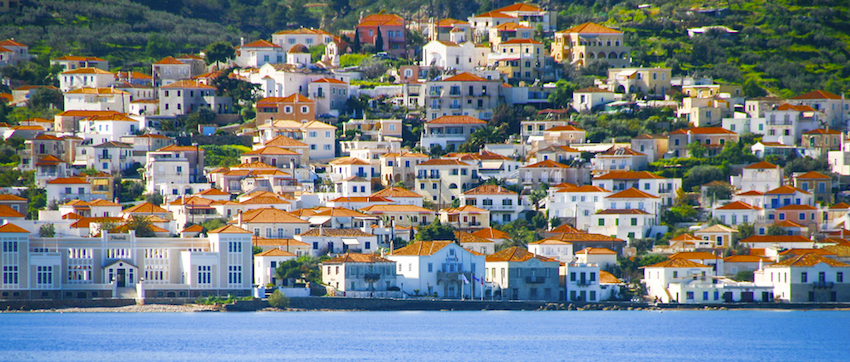
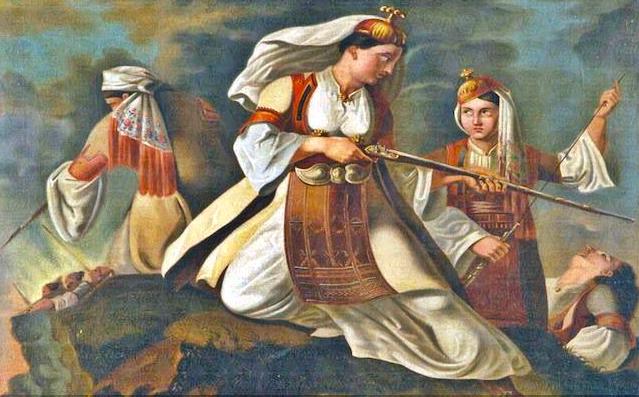 Behind the unassuming, mostly low buildings are two landmarks that evoke Spetses legends. The first is Laskarina Bouboulina’s house, now a museum. Bouboulina was arguably the most famous Spetsiot ever. An inveterate businesswoman, she managed her own trading ships and ended up leading them into battle when the Revolution was declared. But
the only woman in Greek history to attain the rank of admiral did not enjoy her glory for long. She fell victim to
male treachery and was murdered in 1825 by a fellow islander. Her house, with its inlaid wooden ceilings, “European” furniture, and period paintings, could not be more different from the conventional notion of a Greek island dwelling.
Behind the unassuming, mostly low buildings are two landmarks that evoke Spetses legends. The first is Laskarina Bouboulina’s house, now a museum. Bouboulina was arguably the most famous Spetsiot ever. An inveterate businesswoman, she managed her own trading ships and ended up leading them into battle when the Revolution was declared. But
the only woman in Greek history to attain the rank of admiral did not enjoy her glory for long. She fell victim to
male treachery and was murdered in 1825 by a fellow islander. Her house, with its inlaid wooden ceilings, “European” furniture, and period paintings, could not be more different from the conventional notion of a Greek island dwelling. 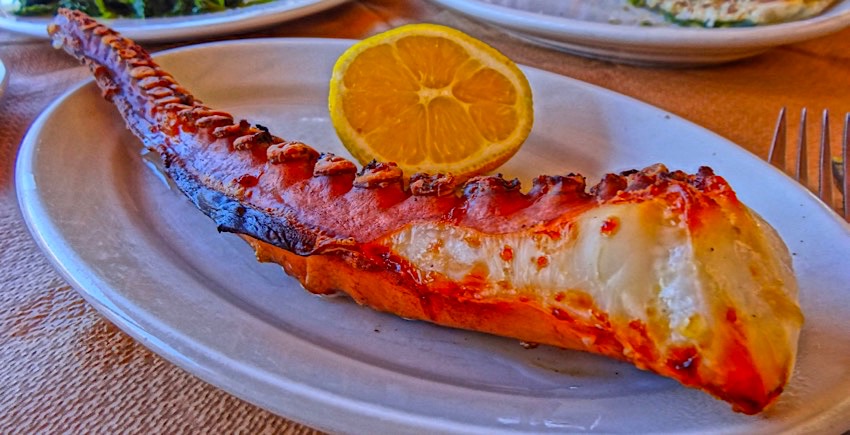
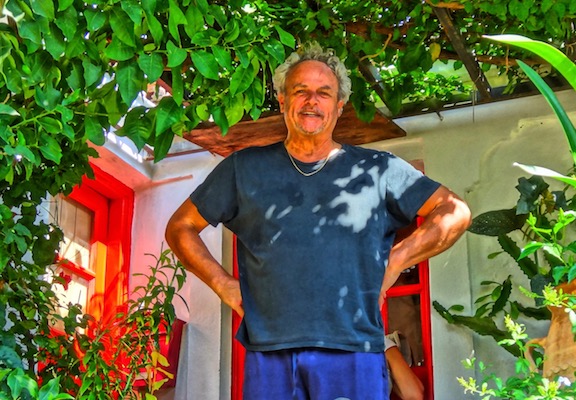 James Foot is an artist who lives in the southern Peloponnesos and exhibits his watercolors every August in Spetses.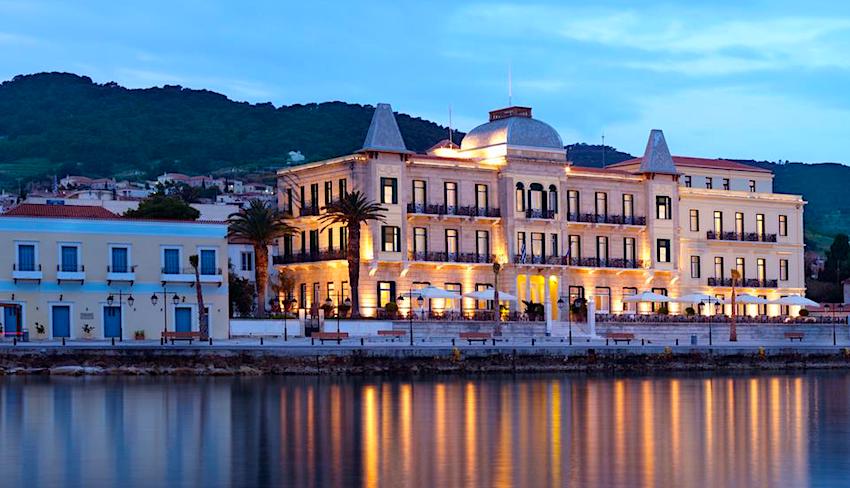

|
|
|
|
|
|
|
Join Matt Barrett's Greece Travel Guides Group on Facebook for comments, photos and other fun stuff. If you enjoy this website please share it with your friends on Facebook. If you are appreciative of all the free information you get on my websites you can send a donation through Paypal Or you can use Venmo at venmo.com/Matt-Barrett-Greece |
|